The 1st International Young Environmental Scientists Conference
Building a Just and Climate-Resilient Future: Youth Innovation for People, Nature, and Climate
The world faces converging crises; climate change, biodiversity loss, and resource depletion that threaten people, nature, and economies, with young people among the most vulnerable yet underrepresented in shaping solutions. Across Asia and the Pacific, early-career scientists are producing innovative research on food systems, energy, oceans, and climate resilience but often lack platforms to amplify their work and engage policymakers.
To bridge this gap, WRI Indonesia will host the 1st International Young Environmental Scientists (YES) Conference on 2–3 December 2025, inviting early-career researchers, young professionals, and students to submit abstracts and join this unique opportunity to share ideas, present findings, and connect with policymakers, private sector, local communities, and civil society organizations.
Conference Themes
The overarching theme of the 1st YES conference is entitled:
"Building a Just and Climate-Resilient Future: Youth Innovation for People, Nature, and Climate”
This year’s theme emphasizes the importance of collaborative and inclusive approaches to solving the world’s environmental challenges. This brought a collective understanding that a just and resilient future can only be realized when solutions are co-created across sectors, disciplines, and communities while also centering the needs of people, protecting nature, and addressing the climate crisis holistically. Research as innovation is key to achieving systemic transformation that benefits both current and future generations.
This theme calls for young scientists, policymakers, practitioners, and community leaders to come together in shaping actionable ideas that uphold justice, strengthen resilience, and ensure the well-being of people and the planet.
The overarching themes will be discussed through six sub-themes:
- 1.1: Improving food systems in Indonesia through sustainably-produced and locally-available terrestrial and/or aquatic protein sources
- 1.2: Advancing behavior change strategies towards healthier diets and/or reduced food loss and waste
- 2.1: Sustainable land and water management, technology and data governance
- 2.2: Nature-based Solutions (NbS) for climate mitigation and adaptation
- 3.1: Advancing Indonesia's economy through sustainable mineral mining and processing
- 3.2: Integrating climate adaptation and resilience in development planning and budgeting
- 4.1: Ocean inclusive climate-economy actions (incl. marine spatial planning)
- 4.2: Marine plastic pollution
- 5.1: Policy reform for sustainable urban mobility in Indonesia cities
- 5.2: Improving land use and housing planning and financing strategy in Indonesia
- 6.1: Low carbon technology for industry
- 6.2: New era of energy system planning
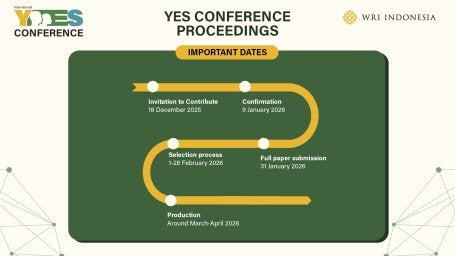
YES Conference Proceedings
The committee invites oral and poster presenters to submit full paper based on the research you presented at the YES Conference for possible publication in the WRI Indonesia Conference Proceeding. Presenters are encouraged to submit their papers; however, submission is not compulsory. WRI Indonesia will select submitted papers that meet WRI standards of excellence. Only selected papers will be included in the proceeding.
General Description
The YES Conference Proceedings is a compilation of selected research papers presented at the 1st International YES Conference organized by WRI Indonesia. It serves as a record of emerging trends in youth-led research. We expect the papers included in the proceeding to be:
Credible: Papers must present a balanced view, be based on appropriate evidence, and be transparent.
Adds value: Papers add value by delivering new insights that deepen understanding of an issue or its context.
Fit for audience: Papers should be written and presented to inform a broad audience.
Well written: Papers should be presented with a clear, focused narrative.
This conference proceeding will be published as a WRI Knowledge Product and will be made available on WRI Indonesia’s website. A disclaimer will be included stating that the contents of the proceeding are not peer-reviewed.
The proceeding reflects the work and/or views of the conference presenters and do not necessarily reflect the views of WRI and other conference partners.
Author Guidelines
Abstract length: between 150 to 250 words.
Paper length: between 3000-4000 words on A4 paper, including tables, figures, and a bibliography.
Paper structure:
Title
Author
Institution/Affiliation
E-mail Address of the Corresponding Author
Abstract & Keywords
Introduction
Methodology
Results & Discussion
Conclusion
Reference
Headings format: use level of heading in writing the section and sub-section without number.
Level 1 headings are used only for the main section titles.
Level 2 headings denote major subsections.
Levels 3 headings denote “sub-subsections.”
References: Please use the reference management system and use the Chicago Style. Do not use footnotes, endnotes, and appendixes.
Tables and Figures: Every table/figure heading must include a number (Table 1. Table tile/ Figure 1. Figure title) and its source.
Table numbering:
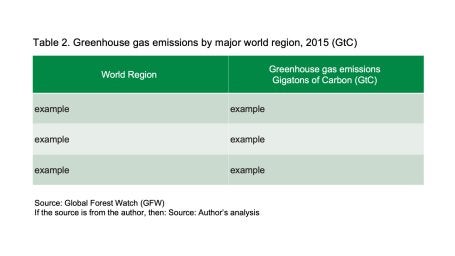
Figure numbering:
Figure 1. Deforestation in Latin America, 1990–2010 (million ha)
Source: Global Forest Watch (GFW)
If the source is from the author, then: Source: Author’s analysis
Submission Process
Ensure that you have proofread your manuscript before submitting.
Ensure that your paper is original and text similarity should be below 15%; the author may check similarity through a plagiarism checker.
Send your paper in Microsoft Word format (.docx/.doc) to [email protected]
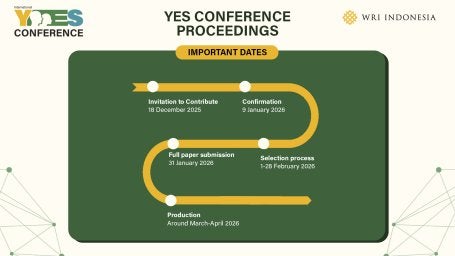
Timeline
Scientific Committee
Prof. Ir. Puji Lestari, Ph.D.
Dr.phil. Hendricus Andy Simarmata, IAP
Dr. Nirarta Samadhi
Dr. Arief Wijaya
Dr. Ahmad Dhiaulhaq
Catch the full recording here: