

Alat PRINSIP: Empowering Papuan Communities through Renewable Energy Access
From 2021 to 2024, WRI and Arup have collaborated on an idea for rural communities to access renewable energy to increase production and profitability of sustainable commodities, while reducing impacts on nature. The project’s geographic focus is on Indonesian Papua (hereafter known as Tanah Papua), a critical front for global climate action and nature that exemplifies the global challenges on rural development and nature conservation. Beyond natural resource exploitation, few sustainable economic alternatives exist. With limited livelihood and business opportunities, unsustainable options are often seen as the only pathway out of poverty for many rural Indigenous Papuans. While a business case for economic development based on other more sustainable land-use activities can be done in theory, rural communities lack essential support – from capacity and business capability, viable transport and affordable energy – for these to work. Despite the immense value healthy environments such as Tanah Papua’s intact rainforests provide to global climate action, little to no international finance or recognition is provided to such areas to maintain these critical natural capital resources.
In response to this urgent need, the Arup and WRI project team aimed at developing a low-carbon solution to empower rainforest communities in Tanah Papua to enable sustainable livelihood opportunities. We envisioned achieving this goal through a concept to help villages access renewable energy by identifying their current and future electricity needs, develop a proposal to secure funding for renewable energy facilities. These will then improve opportunities for villages to develop sustainable livelihoods and businesses based on commodity production that will not degrade the rainforest. Therefore, we raised a key question on “How can improved access to renewable energy power, sustainable livelihood, and business development opportunities for rural rainforest communities in Tanah Papua?”
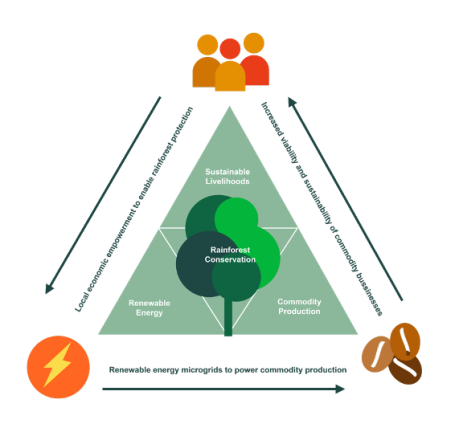
Source: WRI and Arup design concept.
Renewable energy was identified as the key low-carbon development intervention that can leverage Arup and WRI’s combined skillset and help empower rural communities to access the other enabling interventions. This ultimately informs our problem statement:
Why Sustainable Livelihoods and Commodity Production?
With most rainforest communities reliant on farming, there is opportunity to develop diverse and small-scale commodities (e.g. taro, cocoa, coffee and nutmeg) that are produced and harvested using practices that are more sustainable than ‘business-as-usual’ commodities of palm oil, logging and pulp which require clearing of rainforest. Sustainable, small-scale commodities can help shift the notion that farming practices and economic development must come at the cost of deforestation and forest degradation, while their associated livelihoods provide rainforest communities with an increased and reliable income and business model. This can reduce the short-term incentive gained from other environmentally exploitative activities such as selling land to industrial palm oil or logging concessions.
Why Renewable Energy and Commodity Production?
Sustainable production and processing of commodities into viable livelihoods and business can be supported with a fit-for-purpose renewable energy solution that leverages the natural capital assets of rainforest communities (especially flowing freshwater). Electrification from renewable energy can also help reduce costs of production and improve reliability and value-add / preservation of farmed commodities. Focusing on renewable energy access is also timely and in line with the global energy transition necessary to meet international climate agreements and national determined contributions. Benefits of electrification are expanded in the following pages.
Why Rainforests in Tanah Papua?
Noting the inherent benefits rainforests bring, this program offers a key low-carbon development proposition. While having and the largest remaining rainforest left in the Asia-Pacific, Tanah Papua’s healthy natural environment is juxtaposed with having the lowest Human Development Index (HDI) in Indonesia. Economic activities relating to logging and palm oil plantations that have already seen widespread deforestation in Sumatra and Borneo can be averted in Tanah Papua by interventions that support alternative economic development.
Addressing a Much Needed Gap
While this solution can be potentially catalytic, WRI and Arup found that only a handful of entities are currently working on this issue in Tanah Papua. The solution’s focus on rural electrification through renewable energy can offer rainforest communities a rare opportunity to take part in Indonesia’s growing economy and realise the opportunities of global transition.
Access to electricity is not a cure-all, but it is a critical enabler of sustainable development in rural and remote communities, opening pathways to greater productivity, better health and education, safer access to water, and improved communication services. For communities that rely on commodity production, the gains can be immediate and tangible. Electric-powered processing lets households produce more in less time. Mechanically processing a sago tree takes a single day, compared with around five days by hand, so the same work earns more income. Electricity also makes it possible to add value to raw produce, for example by turning harvested taro into chips or cakes to sell at market. Refrigeration allows perishable goods such as seafood and meat to be stored, which means fewer long trips to distant markets and more freedom for sellers to choose when and to whom they sell. Without the pressure of produce spoiling, communities are better placed to avoid middlemen who exploit that urgency to drive down prices, and can secure fairer returns. Beyond these economic benefits, reliable lighting and charging facilities strengthen access to communications, education, media and leisure, improving the community’s overall welfare.
Alat PRINSIP as a Potential Digital Solution
As a result of stakeholder engagements on the challenges and opportunities for renewable energy, the project team conceptualised a delivery mechanism provisionally named ‘Alat PRINSIP’. Initially ideated as a digital tool to help communities understand their electrification needs to support forest-friendly livelihoods, our vision is to build a transformative community engagement approach that enables communities to assess energy needs, estimate implementation costs, and generate funding proposals – with the support of an open-source, web-based platform – to secure a thriving and environmentally-conscious future (Figure 2).
Having a web-based platform (i.e. the “digital tool“) is key to Alat PRINSIP, as it aims to put the knowledge of subject matter experts (such as international consultants like Arup) into the hands of local communities and their representatives and development partners (such as local CSOs / NGOs, engineers and local governments). With access to knowledge, local stakeholders can then:
- Understand and assess the opportunities for electrification in their community;
- Design electrification solutions appropriate to their needs and requirements;
- Assess costs and benefits of the proposed solution for that community and consolidate into funding application / feasibility study; and
Advocate for support / funding to deliver the electrification solution developed under this approach.
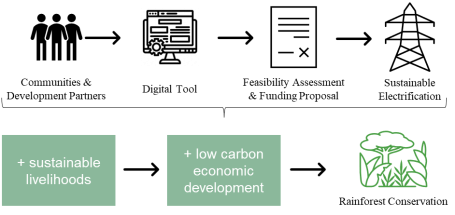
Figure 2: The Alat PRINSIP community engagement approach to access renewable energy. Source: WRI and Arup design concept
Providing there is a coordinated approach to address the issues and risks outlined in the previous section, deployment of the Alat PRINSIP can empower rural rainforest communities to access reliable and affordable electricity from renewable solar or micro-hydro systems to power sustainable livelihood and business development opportunities. Enabling sustainable livelihood opportunities in turn helps alleviate pressures and threats on nearby rainforests ecosystems.
The digital tool component of Alat PRINSIP ensures ‘users’ have access to the technical, commercial, and social feasibility assessment components to support community-driven electrification initiatives. While rural rainforest communities will be the primary beneficiary, the main ‘users’ of the tool at this stage are envisioned to be experienced CSOs / NGOs and / or engineers.
While Alat PRINSIP is tailored to address the economic development challenges faced by rainforest communities in Tanah Papua, its application can potentially be scaled and replicated to other regions, benefiting both rural communities and the invaluable ecosystems they live alongside. Having tested the Alat PRINSIP concept in two locations in Southwest Papua and West Papua province, we believe Alat PRINSIP has potential to be a catalytic enabler of sustainable electrification, rural livelihood improvement, local business development, and nature preservation. With a desirable concept proven, WRI continues to refine the Alat PRINSIP methodology with the aim of piloting this with local governments in priority areas off-the-grid.
Partners:
- Pioner
- Bentara Papua
- Mnukwar Papua
- Yayasan EcoNusa
- Universitas Papua
- West Papua Provincial Government
- Southwest Papua Provincial Government
- Tambrauw Regency Government