

At COP30, the Minister of Environment Discussed the NDC Operationalization with WRI Indonesia
Belém, 17 November 2025 - Indonesia has submitted its Second Nationally Determined Contribution (SNDC) on 27 October 2025 and reaffirmed its commitment to reducing greenhouse gas emissions. Using the 2019 base year as a reference point, Indonesia also strategically addressed adaptation measures and integrated Just Transition until 2035. The country's most ambitious scenario aims to achieve an emissions level of 1,26 GtCO₂e by 2035.
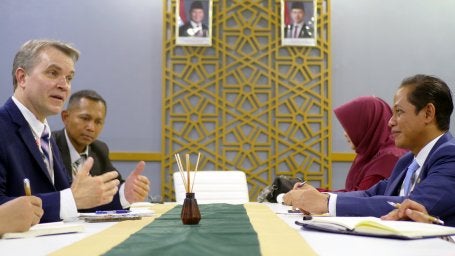
During the bilateral meeting, Indonesia's Environment Minister Hanif Faisol Nurofiq and Craig Hanson, Managing Director and Executive Vice President for Programs at World Resources Institute, agreed on several details regarding support for Indonesia's current commitments to reinforce cooperation on climate and environmental issues. In particular, they discussed the implementation of the SNDC.
On 17 November 2025, both parties met at COP30 to affirm the partnership through following areas of cooperation: a) developing roadmaps to ensure that implementation plans for all sectors are achieved on time; b) supporting the development of Indonesia's investable SNDC plan to emphasise the importance of the link between development and climate action in its implementation; and c) developing Indonesia's SNDC tracking tool to monitor the progress of SNDC implementation in Indonesia.
“Given the substantial developments in Indonesia’s climate and environmental policies over the past years, including the SNDC, I believe that the time is right for us to continue and strengthen our collaboration on climate and environment cooperation. This commitment would allow us to formally capture these latest policy shifts and align our cooperation with Indonesia’s current priorities and future direction,” according to the Environment Minister of Indonesia, Hanif Faisol Nurofiq.
“World Resources Institute believes that every country should be able to achieve its climate commitments. For Indonesia, this moment offers a critical opportunity to raise the country’s aspirations through ongoing collaboration that can support a just transition and strengthen Indonesia’s socio-economic development,” said Craig Hanson.
Since 2025, the Ministry of Environment of Indonesia has been working closely with the World Resources Institute Indonesia to prioritise climate and environmental cooperation. As Indonesia moves into the implementation phase of the SNDC, it is essential to adopt a more strategic approach to our work, ensuring the partnership benefits the country’s people, nature, and climate.