

Comfort and Security-Based Mobility Strategy to Adapt to Urban Complexity

This article is part of the Pojok Belajar Rakyat Kota untuk Inisiatif Inklusif Rendah Emisi (PARKIR) Jakarta program, a collaborative research and knowledge archiving initiative involving women, people with disabilities, urban village residents, and young people to identify challenges and opportunities for inclusive and low-carbon mobility. PARKIR is supported by the UK Government through UK PACT (UK Partnering for Accelerated Climate Transitions).
***
Close proximity doesn't guarantee comfort
Walking in Jakarta often presents a stark contrast between accessibility and security. Kinan, who traveled from East Jakarta, experienced this firsthand. She was surprised by the Palmerah area, located near the DPR Building and a row of fancy buildings, yet the cityscape lacked order and comfort. Similar situations arise in neighborhoods like Rawa Belong and Palmerah in Jakarta. Although Rawa Belong’s sidewalk was repaired recently, pedestrian access is still confined to main roads. As a busy traffic hub, Palmerah is constantly bustling and noisy, especially during rush hours. This environment, combined with a lack of natural surveillance from the surrounding community, renders walking uncomfortable and perceived as unsafe. Comparable issues plague narrow streets, such as those in Kampung Baru, where Risma observed that hurried driver behavior directly endangers pedestrians.
These anecdotes demonstrate that proximity to destinations does not automatically ensure a comfortable or safe walking experience in the city. Mobility strategies must weigh both access and security to adapt to complex urban environments. The goal is simple: make short walking trips safer and more comfortable for everyone.
Assessing the quality of walking spaces in Palmerah
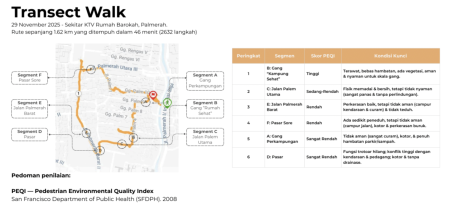
On Saturday, 29 November 2025, our team conducted field observations in Palmerah using the Transect Walk method, starting from KTV Rumah Barokah. The 1.62 km route took 46 minutes (2632 steps) to complete, with assessments based on the Pedestrian Environmental Quality Index (PEQI). The San Francisco Department of Public Health (2008) developed this comprehensive indicator to assess pedestrian environment quality based on safety, comfort, and accessibility.
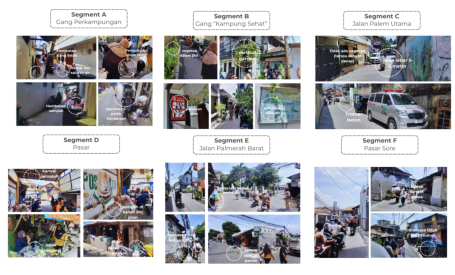
Results show a highly fragmented walking space quality. Only one of the six segments—Segment B (Gang "Kampung Sehat")—received a “High” rating. This segment demonstrates that a well-maintained, barrier-free, and green walking environment is achievable.
On the other hand, most segments, including Segment D (Market) and Segment A (Village Alley), scored "Very Low", characterized by disarray, steep inclines, and severe spatial conflicts. Meanwhile, Segments E (Jalan Palmerah Barat) and F (Pasar Sore) received "Low" scores, underscoring a critical safety issue: pedestrians must share space with vehicles, with no dividers or shade, posing significant risks.
Accessibility that embraces user diversity
Beyond physical and safety concerns, walking spaces in urban areas can cause sensory overstimulation for some individuals, including those with mental or psychosocial disabilities. The combination of loud traffic noises, unpleasant odors from garbage and wet food ingredients, heat radiating from hard surfaces, and visual chaos in market areas can lead to discomfort and disorientation. This environment transforms walking from a simple act of mobility into a psychological burden, demanding extra energy to maintain focus and a sense of security. At the same time, people with physical disabilities face mobility barriers due to non-compliant infrastructure. The walking paths often exceed the standard slope of 1:12 (approximately 8.33%), while the ideal incline ranges from 2° to 5°. In addition, the lack of a minimum barrier-free space width of 150 cm or 200 cm severely limits independent mobility.
Field observations reveal stark contrasts in experiences. In shadier, quieter areas like cemeteries, users report a significant reduction in sensory overload. Such spaces provide a vital respite, allowing individuals to regain a sense of comfort and control over their surroundings.
This phenomenon confirms that mobility security and comfort demand a broader definition that extends beyond technical standards. National guidelines such as Pd 03-2017-B andMinister of Public Works and Housing Circular Letter No. 02/SE/M/2018 mandate accessible sidewalks, ramps, rest areas, guideways, and public transportation connectivity. These provisions are further reinforced by the Minister of Administrative and Bureaucratic Reform Circular Letter No. 66/2020, Presidential Decree (PP) No. 16/2021, the universal design guidelines (PUPR 2022), the Universal Standards Guide for Persons with Disabilities, the UN Convention on the Rights of Persons with Disabilities (UN CRPD), and Law No. 8 of 2016 concerning Disability. In alignment with the 2020–2024 RPJMN, mobility strategies must now integrate sensory and psychological considerations. This approach helps create environments that are safe, comfortable, and truly accessible to everyone, including people with physical, sensory, and psychosocial disabilities.
The power of social security in mobility
Agustini, a long-term Palmerah resident, highlighted how intimate local contexts profoundly shape her extensive walking experience. "Walking in the alley provides a sense of security," she stated—a feeling our axial coding analysis categorized as 'Security as the Foundation of Mobility.’ This security, stemming from social familiarity and natural surveillance, is essential for her daily walks to the park, market, or mosque, activities grouped as 'Daily routine' and 'Priority destinations' in our open coding.
However, walkability remains tied to physical conditions. Interventions like upgrades in the Rawa Belong area must assess whether infrastructure improvements also address inclusivity for people with disabilities and the elderly. Selective coding indicates that citizen mobility strategies adapt to the complexity of urban environments. Any enhancements in walking infrastructure should strengthen, rather than disrupt, the established “Circle of Comfort.” This involves creating a sense of security rooted in existing social infrastructures, thereby laying the groundwork for broader physical accessibility that is more inclusive and user-friendly.
A city that supports all citizens' mobility
This essay highlights Jakarta's urban complexity, evident in its contradictory walking experiences. Fragmented PEQI assessment results demonstrate that sensory challenges for people with disabilities require comprehensive, not partial, solutions. Adaptive mobility strategies must be integrative, establishing comfort and safety as universal foundations. Walkability extends beyond mere sidewalk repairs, such as those in Rawa Belong; it requires creating an inclusive walking ecosystem free of vehicle conflicts, comfortable in terms of sensory experiences, and supported by social surveillance, as appreciated by residents in the alleys.
Shifting the paradigm from vehicle-based to human-based mobility is the main goal. The city government needs to adopt holistic measurement tools, such as the PEQI, as standards for planning and budgeting. This ensures all pedestrian infrastructure meets criteria for safety, comfort, and accessibility for everyone, including individuals with physical, sensory, and psychosocial disabilities. The community can contribute by creating shaded spots and transitional spaces that reduce sensory overload. As citizens, we can be agents of change by choosing to walk for short distances. When equal mobility is guaranteed, cities become not only efficient but empathetic. Every citizen’s step gains value, every individual feels recognized, and no one is left behind in accessing city life with dignity. To maintain safe and sustainable urban mobility, the government should conduct regular user satisfaction surveys and strengthen public participation to improve services, especially for women, people with disabilities, and the elderly.