Featured WRI Experts:
Lihat juga:
karbon



Artikel ini hanya tersedia dalam bahasa Inggris
At COP30 in Belém in 2025, Indonesia committed to facilitating greater international participation in its carbon market. The adoption of Presidential Regulation (Perpres) No. 110/2025 on Carbon Economic Value Instruments and National Greenhouse Gas Emissions Control—replacing Perpres No. 98/2021—marks an important step in reshaping Indonesia’s carbon market landscape. Indonesia is in a decisive position to balance national emissions targets, international carbon trading, and the integrity of its carbon pricing mechanisms, and recent policy developments signal its concrete climate ambitions.
In theory, putting a price on carbon should induce the market to identify and implement cost-effective means to reduce emissions. When carbon is not priced, the costs of emissions may be borne by other parties rather than the polluters themselves. Setting a price on Greenhouse Gas (GHG) emissions provides an economic incentive for emitters to reduce their emissions. In accordance with theory, several studies have shown that, when introduced alongside other supporting policies, carbon pricing is one of the most cost-effective tools available for cutting emissions and driving low-carbon innovation.
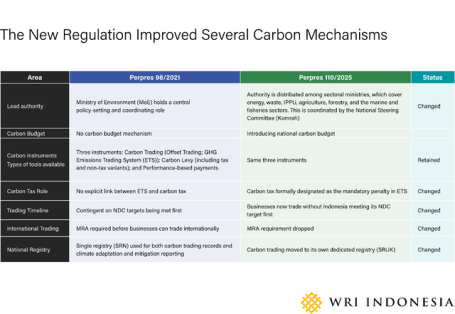
Perpres 110/2025 introduces several institutional changes relative to Perpres 98/2021. Under the previous regulation, the Ministry of Environment (MoE) held a central policy-setting and coordinating role in implementing carbon pricing instruments, as further regulated through MoE Regulation 21/2022. The new regulation alters this by distributing substantial authority to sectoral ministries responsible for the relevant sectors and subsectors, including energy, waste, industrial processes and product use, agriculture, forestry, and marine and fisheries. These ministries now have greater power to regulate carbon trading within their own sectors. These changes have also been reflected in the recent progress within relevant ministries in developing or revising implementing regulations, such as the issuance of Ministerial Regulation No. 6/2026 by the Ministry of Forestry on carbon trading through greenhouse-gas emissions offsets in the forestry sector.
Through the revision of the National Steering Committee (NSC), known in Indonesian as Komite Pengarah (Komrah), accelerated cross-ministerial policymaking and implementation will be a priority. NSC’s mandate now expressly includes leading cross-ministerial coordination, supervising implementation, and evaluating carbon economic value instruments. Further, the committee is now chaired by the Coordinating Ministry of Food Affairs (CMFA) and vice-chaired by the Coordinating Minister for Economic Affairs (CMEA) and the Coordinating Minister for Infrastructure and Regional Development (CMIRD). Additionally, several new members have been added, including the Financial Services Authority (Otoritas Jasa Keuangan; OJK), the Ministry of Foreign Affairs (MFA), and the Ministry of Investment and Downstreaming (MID).
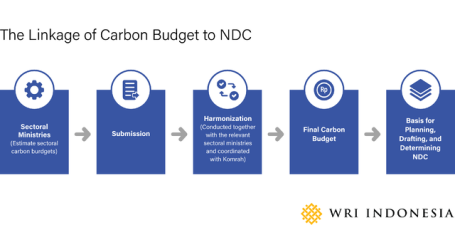
The new regulation also introduces the carbon budget, which is to serve as a basis for formulating Indonesia’s NDC, the country’s climate commitment under the Paris Agreement. The carbon budget, the total amount of CO2e permitted during a specific period, is to be determined through a bottom-up approach involving each sectoral ministry. With due consideration for the carbon reserve, each ministry is to estimate its sector’s allowable emissions, taking into account National Development Plans, GHG emissions data, and economic factors (Article 3, Paragraph 2). These estimates are then brought together and harmonized under Komrah's coordination before a final national carbon budget is agreed upon.
Three carbon pricing instruments are discussed in the regulation: Carbon Trading (including Offset Trading and GHG Emissions Trading System (ETS)); Carbon Levy (including tax and non-tax instruments); and Performance-based payments. These instruments may be grouped by two characteristics. First, by regulatory function: compliance instruments include ETS and carbon tax, while voluntary instruments include offset trading or the Voluntary Carbon Market (VCM), performance-based payments, and other non-tax carbon levies. Second, by instrument design: market-based instruments include offset trading, ETS, and carbon tax, whereas non-market-based instruments include performance-based payments and non-tax carbon levies.
Several changes to the way these instruments work are worth noting. Under PR 110/2025, the carbon tax has been formally designated as a penalty for businesses that exceed their emissions quota under the ETS (Article 63, Paragraph 3), further formalizing the cap-and-trade system. Businesses are also now permitted to trade carbon credits without waiting for Indonesia to meet its NDC targets (Article 58, Paragraph 1), which is intended to accelerate market activity. The same article (58), paragraphs 3–4, also stipulates that a national roadmap must be formulated when carbon trading is enacted. This process will be coordinated by Komrah, who will gather all the relevant sectoral ministries to jointly regulate the roadmap.
For international trading, Article 68, Paragraph 1 of the new regulation explicitly recognizes the role of Corresponding Adjustment (CA), a mechanism to prevent double counting of emissions reductions in international carbon trade. These include internationally linked trading and the fulfillment of Paris Agreement obligations (6.2 and 6.4), as well as other voluntary offset trading to fulfill other international obligations. Moreover, previously businesses wishing to trade internationally needed a Mutual Recognition Agreement (MRA) with the relevant foreign counterpart. PR 110/2025 drops the MRA requirement, giving businesses more freedom to choose their own international crediting methodology.
Finally, all carbon trading transactions – domestic and international – must be recorded in a dedicated national registry called the Sistem Registri Unit Karbon (SRUK) according to Article 59, Paragraph 1. This is a change from the previous system, where carbon trading records were kept alongside climate adaptation and mitigation reporting in a single registry called Sistem Registri Nasional (SRN).
The updated carbon mechanism regulation marks a meaningful step forward, but it also sets off a chain of actions that must follow. As of July 2026, the Ministry of Environment launched the Carbon Unit Registry System (Sistem Registri Unit Karbon or SRUK) to replace the National Registry System (Sistem Registri Nasional or SRN). The SRUK mechanism allows integrated harmonisation across ministries that were once separated into different systems. These changes will align with regulations set by each ministry, such as Ministerial Regulation No. 6/2020 at the Ministry of Forestry, with other ministerial regulations expected to follow. The launch of SRUK also provides a foundation for future enhancements to registry functions, particularly to support Indonesia’s participation in the international carbon market under Article 6 of the Paris Agreement.
Against this backdrop, Indonesia should prioritize a phased reform agenda that strengthens both compliance and voluntary carbon markets, starting with clear national carbon budgeting, alignment with the NDC, carbon tax and ETS design, and the institutional roles needed for implementation. In parallel, sectoral regulations should be completed to unlock voluntary market readiness, improve MRV, and support high-integrity project development. Over the medium to long term, the focus should shift toward tighter ETS alignment with national targets, stronger market integrity and liquidity, and deeper institutional and digital reforms that can sustain investor confidence and position Indonesia for credible international participation.
With support from the UK Government through the UK PACT (Partnering for Accelerated Climate Transitions), PRICE (Policy and Regulatory Framework for Indonesia’s Carbon Pricing Ecosystem) project consortium, comprising the World Resources Institute (WRI) Indonesia and the Indonesia Research Institute for Decarbonization (IRID), is collaborating with relevant sectoral ministries to advance carbon pricing policy and regulation in Indonesia.