

Explore more:
Cities & Transport
Overlooked Sounds, Paths, and Sign Language

Children in Barrang Lompo Island are playing and running after school. Image by
PARKIR Makassar
Key Takeaways
-
The communities in Barrang Lompo Island face mobility obstacles due to narrow roads, inaccessible infrastructure, and a lack of communal safety regulations.
-
People with disabilities and Deaf individuals on the island still experience limited access to education, communication, and independence in daily life.
-
Inclusiveness in the archipelagic area requires real support through improvements to public facilities, communication access, and mobility systems that are safe for the community.
This article is part of the Pojok Belajar Rakyat Kota untuk Inisiatif Inklusif Rendah Emisi (PARKIR) Makassar program, a collaborative research and knowledge archiving initiative involving women, people with disabilities, urban village residents, and young people to identify challenges and opportunities for inclusive and low-carbon mobility. PARKIR is supported by the UK Government through UK PACT (UK Partnering for Accelerated Climate Transitions).
***
Barrang Lompo, located at Spermonde Island (approximately 13 km from Makassar City), represents more than just a small dot on the map. Barrang Lompo is a space forged by maritime activities, trade, and interactions among residents, now serving as a repository of inherited customs and values.
Local belief practices passed down through generations persist within the coastal community life of Barrang Lompo Island, which remains synonymous with maritime culture. One example of this is the disaster-warding rituals where residents offer young bananas, red candles, incense, water, and specific foods. These offerings carry symbolic meanings intended to protect the village and its families from danger, disease, and bad weather. Such practices demonstrate how traces of animism coexist with Islamic teachings through cultural syncretism in the social life of island communities.
Visitors frequently visit three cemeteries as sites for rituals of hope. These sites include tombs of scholars recognized as the first generation of Islam's spreaders, and tombs of the village's founding figures, which preserve the spirit and existence of the island's inhabitants. Moreover, Malay graves, including Chinese graves, also provide evidence of strong acculturation. In addition, names like Chinese village, Mandar village, and Dollar village foster harmony within a predominantly Makassarese society.
On the other hand, Barrang Lompo Island illustrates how density and limited land shape community movement. Narrow neighborhood roads serve as shared spaces for various modes of mobility, including pedestrians, motorbikes, electric bikes, and odong-odong, which pass by nearly all day long. In these situations, pedestrians pull over whenever a vehicle passes. No clear pattern dictates priority, and no shared understanding defines direction or paths. Residents move instinctively, following habits rather than rules.
Some people view this as a minor inconvenience. However, for people with disabilities and mobility issues, these conditions determine their range of movement. Within this context, the experiences of Rabiah, Maudu, Suryandi, and Aulia demonstrate how residents navigate the same space in vastly different ways.
Steps Stalled in Front of the House
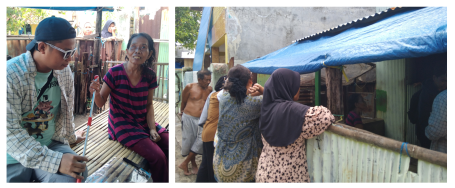
Rabiah, 60 years old, sits in a bamboo hall sharing a portion of her life story. Total blindness struck her suddenly more than a year ago, beginning with nausea at 2 AM on a Friday. She lost her sight from that moment onward.
Rabiah remains unmarried and lives alone in her house. She can no longer cook, so neighbors kindly take turns delivering food. During our meeting, her older brother, Jumain Daeng Nai from Takalar, visited to deliver the rice he is selling to Barrang Lompo Island.
Occasionally, Mrs. Rabiah ventures onto the road in front of her house. Her feet slowly navigate the path without a mobility cane. "I'm afraid of walking far. I'm afraid I'll crash or be hit," she says. Before losing her sight, she would go around the island daily selling cakes. Now, she only walks as far as her house fence.
Sailing Amidst Limitations
Maudu also experiences mobility barriers. This 61-year-old man has four children, eleven grandchildren, and one great-grandchild. He still goes to sea despite his paralysis. To reach the water, he rides a motorbike from his house to the beach. He relies on others, specifically his wife and children, because he lacks mobility aids.
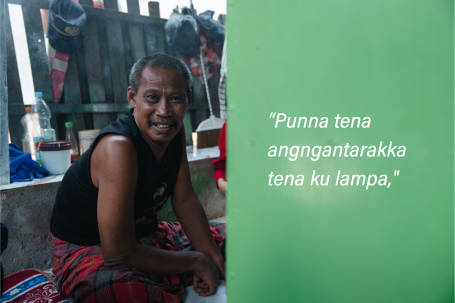
Photo: Memora for WRI Indonesia
He will stay at home if no one can drop him off. He goes squid fishing on Bonebatang Island using a self-driven outrigger boat. During overnight trips, he catches only 1–2 kg of squid. He often returns with half a kilogram, which he sells for Rp. 30,000. Bad weather sometimes restricts his fishing to the area around Barrang Lompo Island. On these occasions, he often soaks in the water until morning, waiting for his wife or children to pick him up upon his return.
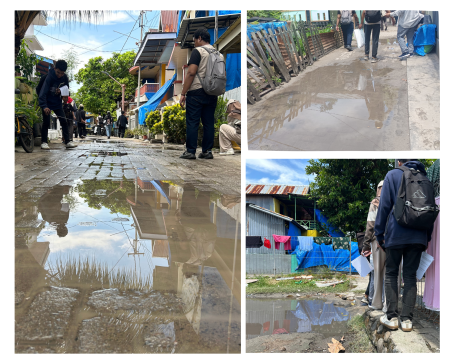
We frequently encounter obstacles as we approach various houses. Motorbikes, electric bikes, and odong-odong fill the roads, which measure only 3–4 meters wide, forcing pedestrians to move aside whenever a vehicle passes. No clear traffic pattern exists. Drivers operate as they please without attending to the left or right lanes. A fast, silent electric bike almost struck one of us while walking on the left edge. This happens despite Law No. 22 of 2009, which designates the rightmost lane for faster vehicles.
In fact, guiding blocks have been provided on several roads. Unfortunately, many are damaged, rendering them inaccessible to person with a visual disability. Guiding blocks also concentrate at specific points, for example, along the 170-meter stretch from the pier to the Sub-District Office. Uneven paving blocks and scattered puddles also hinder movement for residents, including people with disabilities.
The Story of a Deaf Person Hidden Behind the Waves
The Barrang Lompo excerpt does not stop at local rituals, fishermen's stories, and inter-island journeys within the urban administrative area. Barrang Lompo is also a place where the deaf community shares their stories, like the friends we met, Suryandi and Aulia.
Suryandi lives a life of limitations that stem not only from his hearing, but also from an environment that is not yet inclusive. Since his parents passed away, Suryandi has lived with his older brother in the family's modest house. He spends most of his days at home, helping to care for his nephew/niece.
To make a living, Suryandi works odd jobs. He provides home massage services for a fee of approximately Rp50,000 and washes clothes for other households. Due to limited mobility, he only dared to go to neighboring houses. At night, Suryandi felt afraid to go out, so his mobility became increasingly limited. Every day, Suryandi uses an electric bike or a bicycle to travel from one place to another. He cannot ride a motorbike and is not allowed to travel far alone, including outside the city. Suryandi only goes out if invited by a neighbor and can travel outside the island if accompanied by his parents. This dependence further limits Suryadi's independence.
In addition to mobility barriers, several conditions make it even more difficult for him to navigate life outside his home. Suryandi doesn't have any close friends. Moreover, his lack of sign language makes it even more difficult for him to communicate. This often causes misunderstandings, even making people around him angry or impatient. As a result, Suryandi became more withdrawn and sensitive, choosing to stay away from social interaction.
Emotionally, Suryandi appears shy, often smiling with his head lowered. He keeps many thoughts unexpressed. Low self-confidence and a closed mind stem from his lack of social support and interaction. To date, Suryandi has never been in a relationship or married. Apart from work, he lacks activities that support self-development or social interaction.
Suryandi never received a formal education. He cannot read or write and has only learned his identity through his ID card with the assistance of others. This demonstrates the minimal access to education Suryandi received from childhood.
Suryandi identifies as a man who dresses like a woman. This interest emerged during his childhood when he lacked a clear understanding of gender concepts and imitated the styles of his female peers. From childhood until now, Suryandi has frequently worn women's clothes. His brothers often forbid him from wearing women's clothes and make-up, but he continues to wear them.
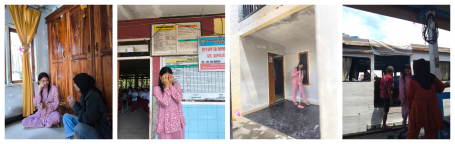
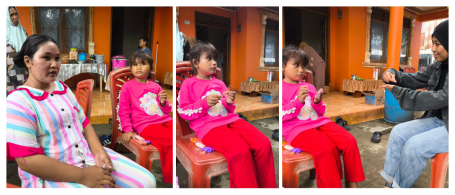
We also met Aulia. She attended a public school on Barrang Lompo Island at age 8. However, the school maintains a non-inclusive learning system. The teacher only asked Aulia to copy writing from the board and provided no special methods suited to her needs as a deaf child.
In her daily life, Aulia does not actively use sign language. She acts shy and chooses not to respond directly to invitations to communicate when people call or invite her to interact. However, Aulia uses simple gestures as an alternative form of communication. For example, she imitates the movements of eating ice cream to convey her desire for it. Aulia also prefers interacting with her mother to interacting with other people. In social situations, she often redirects her attention to things she likes, such as clay, when others try to communicate with her. This behavior shows her own way of building a sense of security and comfort.
The neighborhood lacks advocacy or support for the inclusion of deaf individuals. This environment forces Aulia to grow up without adequate communication access and places her at risk of language and social development delays.
The stories of Suryandi and Aulia make clear that inclusion for deaf individuals remains limited and warrants serious attention. Primary obstacles include a lack of access to sign language, which is key to communication, and a non-inclusive education system that fails to provide adaptive learning methods. These factors hamper future opportunities. Low environmental awareness exacerbates this condition, as residents do not yet understand how to interact with deaf people, often leading to misunderstandings. Furthermore, the absence of social support and inclusive community spaces leaves individuals feeling isolated, while a lack of independence training limits their mobility and confidence in making crucial life decisions.
This situation demonstrates that travel involves more than moving from one place to another; it defines who can actually be mobile.
The existence of odong-odong presents another reality. On one hand, they provide a means of transportation and cheap entertainment for island residents. They serve as rides for children traveling to take Quran lessons or to visit local kiosks. In addition, mothers frequently use them to put their children to sleep during the day. On the other hand, loud music from these vehicles disturbs the orientation of the blind. These vehicles dominate the narrow roads already crowded with motorbikes, bicycles, and electric bikes.
Therefore, residents must reach an agreement to regulate road use, repair basic infrastructure like paving and guiding blocks, and establish technical guidance for driving safety. In addition, providing mobility aids, simple visual signs, and clear information on roads and on board remains vital so everyone, including people with disabilities, can be aware of which direction to go. In the end, a journey should not stop halfway; it should bring everyone to their destination safely and comfortably.