Explore more:
food
Press Release
From a Plate of Food, Bandung Learns to Waste Less
On Saturday morning, July 11, Bandung was only just beginning to stir. At Nara Park, people began to arrive. Amid conversations and the aroma of food drifting from restaurant kitchens, a problem that often goes unnoticed was being brought into focus: food left uneaten on our plates.
Leftover rice, pieces of vegetables, fruit peels, or food that has barely been touched may seem like small matters. Once a plate is cleared by a server, the leftovers disappear. But for a city, the journey of that food waste is far from over. It enters a waste management system that must handle thousands of tonnes of waste generated every day by households, markets, restaurants, and various businesses.
Bandung generates around 1,492 tonnes of waste every day, with approximately 44–45 percent consisting of food waste. This substantial volume is documented in data from the Bandung City Environmental Agency for 2024. The figures show that food waste is not only about what happens after food is discarded, but also about the decisions made much earlier: how much food is taken, ordered, prepared, and ultimately actually eaten.
At the end of the waste management system, this challenge meets the limited capacity of the final disposal site (TPA). The Sarimukti TPA, which has long served as one of the main disposal sites for waste from Greater Bandung, is under increasing pressure from the volume of waste it receives.
In response to this challenge, WRI Indonesia launched the “Tong Kalap, Tong Nyesa!” campaign at Nara Park in Bandung. The campaign is part of Urban Futures, a global programme that promotes sustainable urban solutions, with support from Yayasan Humanis dan Inovasi Sosial and in collaboration with the Bandung City Department of Culture and Tourism.
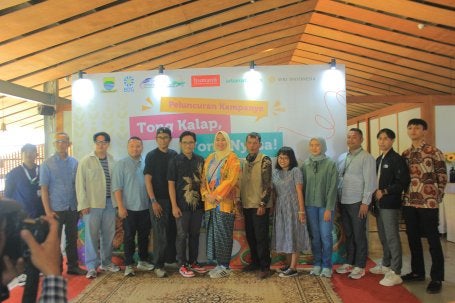
“As food business owners, we also have a responsibility to educate customers to consume more mindfully. Through this collaboration, we hope to be part of that change,” said Erick Jusuf, owner of Nara Park.
Young People in Bandung Who Love Food
More than one-fifth of Bandung’s population is young people. They are not only active consumers of a wide range of products and services, but also have significant influence in shaping new trends and habits. In Bandung, food is almost always within reach-from simple neighbourhood eateries to restaurants and cafés found across the city. Food has become an important part of urban life.
For young people, cafés and restaurants serve a purpose beyond simply eating. Tables become places to meet friends, work, study, create content, have discussions, or simply spend an afternoon over a cup of coffee.
That is why the conversation around food waste is particularly relevant in Bandung. Tong Kalap, Tong Nyesa! campaign places cafés and restaurants as spaces to initiate change while making young people one of its driving forces.
Ten cafés and restaurants joined the campaign as partners: Bagi Kopi Dago, Greens and Beans, Hutanika, Kopitera Burangrang, Milestone, Nara Park, NERD Laboratory, Pho Ngon, Tedja Coffee in Saparua, and Work Unusual. At these venues, visitors will encounter campaign materials, educational games, and interactive activities designed to make the issue of food waste more tangible and relevant to their everyday experiences.
In this way, the campaign goes beyond simply asking people to protect the environment. The message is placed where decisions about food actually happen. A customer decides what to order. A restaurant worker prepares the food. A business owner manages ingredients and operations. A young person may take what they learn back home or into their community. All of them are part of the same chain.
The campaign uses everyday Sundanese language. Tong means “don’t,” while nyesa means “to leave something behind.” Meanwhile, “kalap” describes the tendency to take or order more than needed without considering whether it will actually be consumed.
In the context of the campaign, Tong Kalap, Tong Nyesa! carries a simple message: don’t get carried away when taking or ordering food, and don’t leave behind what you have already taken or ordered.
The campaign aims to encourage people to pause at these small moments of decision. To make the message more relatable to Bandung communities, the campaign introduces Teh Lidi, a mascot inspired by piring anyaman lidi, woven palm-leaf plates commonly associated with eating traditions in West Java. The plate was chosen not simply as a visual element, but as a reminder that the change the campaign seeks to encourage begins with something closely connected to the act of eating itself.
The name “Teh” was also chosen deliberately. Research by WRI Indonesia in collaboration with AdvisLab shows that women play an important role in food-related decisions at home. Teh Lidi is therefore designed as a familiar and warm presence—not someone who judges people for leaving food behind. She is more like a gentle reminder that appears in the middle of everyday eating habits.
When Food Waste Begins to Be Counted
Food waste in restaurants is not only about what customers leave on their plates. Excess food preparation, unsold food, food discarded during preparation, and uneaten portions can all contribute to the same problem.
That is why the ten partner cafés and restaurants are not only being encouraged to communicate the campaign message to their customers. They are also receiving training to measure their food waste and use the data to inform operational improvements.
“This programme has given us a new perspective that reducing food waste is not only the responsibility of customers, but also of food businesses. Through training from WRI Indonesia, we now have food waste data that can serve as a basis for improving operational efficiency. We hope collaborations like this can continue to grow and bring broader benefits to businesses and communities,” said Geza Isprimanto, Store Leader at Milestone.
This perspective is beginning to emerge in everyday interactions with customers. One partner discovered that the habit of ordering too much food does not necessarily mean customers need more food.
“At first, many customers would order a milk coffee, snacks, and a rice bowl at the same time because they thought they might as well. After the Tong Kalap, Tong Nyesa! campaign table tents were put up, they started asking the barista about food options and portions that suited them. From that, we realised that leftover food was not always due to the taste not being right, but could be because the portion was simply too much. We were initially worried that offering more reasonable portions would reduce sales, but it turned out that customers actually came back to try other menu items. Food waste decreased, while repeat orders increased,” said Dian Andriani David, Operations Manager at Bagi Kopi Dago.
Through October 2026, WRI Indonesia will also assess whether these interventions lead to meaningful change. Baseline and endline measurements of food waste will be conducted at the ten partner cafés and restaurants, referring to national standard methods issued by Bapanas, Bappenas, and KSPL. These measurement results will be used to assess the effectiveness of the campaign in encouraging behavioural change and reducing food waste.
The campaign also aims to extend beyond restaurant tables. Through Barudak Beraksi, ten groups of young people will be selected to develop and implement food waste reduction initiatives within their communities.
Meanwhile, Barudak Ngajarkeun is designed to equip young people with the skills to become facilitators of waste management education. The module, developed by WRI Indonesia in collaboration with AdvisLab, will serve as a tool for them to bring this knowledge back to their respective communities.
Through this approach, young people are not positioned merely as recipients of a campaign message. They are expected to become messengers who carry that message forward.
Bandung may not become free of food waste because of the Tong Kalap, Tong Nyesa! campaign. However, this campaign aims to start the conversation from one of the places closest to everyday life: the dining table.
Because before food becomes waste, there is always a moment when someone still has a choice. They can take more or take just enough. They can order because they are hungry or simply because something looks tempting. They can leave food behind or finish what they have taken.
That small moment is where change can begin.
Not at the waste bin, but a few steps earlier, when the food is still warm, the plate is still full, and someone can still choose not to leave it behind.**
#####
**This article was made possible with support from Yayasan Humanis dan Inovasi Sosial through the Urban Futures program.