

Explore more:
energy
Press Release
Regional Cooperation Drives Southeast Asia’s Low-Carbon Steel Transition
Bangkok workshop advances regional collaboration on inclusive steel decarbonization
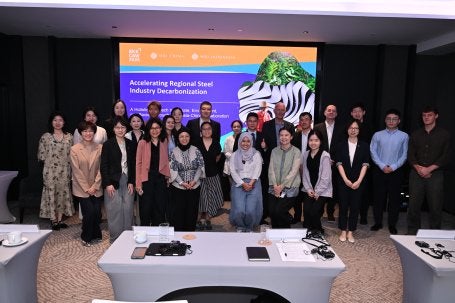
On October 9, 2026, the China and Indonesia teams of World Resources Institute (WRI) co-hosted a side event during the Bangkok Climate Action Week (BKKCAW) titled “Accelerating Regional Steel Industry Decarbonization: A Holistic Approach to Climate, Environment, and Society through Indonesia-China Collaboration.” Representatives from international organizations, research institutions, industry associations, and companies across China, Indonesia, and Southeast Asia gathered to discuss steel decarbonization, green trade, regional value chain cooperation and pathways toward a just transition.
A Critical Investment Window for the China–Indonesia Steel Value Chain
Dr. Fang Li, Chief Representative of WRI’s Beijing Representative Office, noted in the opening remarks that Asia is the world’s largest producer and consumer of steel. Decarbonizing the sector will require stronger cooperation among countries, across value chains and among a wide range of stakeholders to better align investment, technology, energy and standards.
She emphasized that the China–Indonesia steel value chain presents a unique opportunity for regional emissions reductions. In 2025, the metals sector accounted for approximately of China’s total investment in Indonesia. analysis indicates that effective cooperation between 2026 and 2030 could reduce annual carbon dioxide emissions by an estimated 7 million to 10 million metric tons by 2030.
She emphasized that the China–Indonesia steel value chain presents a unique opportunity to reduce emissions across the region. In 2025, the metals sector accounted for approximately 44% of China’s total investment in Indonesia. WRI analysis indicates that effective cooperation from 2026 to 2030 could reduce annual CO2 emissions by an estimated 7 million to 10 million metric tons by 2030.
At the same time, steel decarbonization will have far-reaching implications for workers, businesses and community livelihoods. A just transition must therefore be fully integrated into decarbonization strategies. During this critical investment window, it is also essential to avoid long-term carbon lock-in from new coal-fired power plants and blast furnace projects.
Steel Decarbonization and Economic Growth Can Advance Together
Dr. Nirarta Samadhi, Country Director of WRI Indonesia, in his opening remarks highlighted steel’s essential role in infrastructure, construction, transportation and manufacturing across Asia. How the industry develops will have profound implications for both regional economic growth and global climate action.
Asia is expected to account for approximately 67% of global steel demand by 2050. Indonesia’s steel production is projected to grow to 2.2 times its current level. If existing production methods continue, this expansion could generate approximately 71.9 million metric tons of CO2 equivalent emissions. At the same time, Indonesia’s steel industry supports more than 300,000 jobs. The country’s steel transition must therefore balance emissions reductions with industrial competitiveness and workers’ livelihoods.
WRI Indonesia is working with local government agencies and the private sector to support the development of decarbonization roadmaps for steel, nickel and other manufacturing subsectors. It is also promoting deeper cooperation between China and Indonesia on technological innovation, financing mechanisms, industrial policy and market development.
A Regional Framework for Green Steel Cooperation
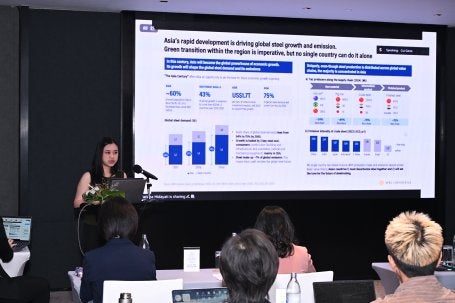
Nada Zuhaira, Industrial Transition Senior Research Lead in WRI Indonesia’s Energy and Sustainable Business Program, outlined key trends shaping Asia’s steel industry in her keynote speech, with a particular focus on Southeast Asia.
She noted that Southeast Asia is undergoing rapid steel capacity expansion while simultaneously confronting the need for a low-carbon transition. The region produces approximately 56 million metric tons of crude steel, with the construction sector accounting for roughly two-thirds of steel demand. In 2023, the ASEAN steel industry generated approximately 81 million metric tons of emissions, with Vietnam, Indonesia and Malaysia together accounting for around 90%. Without substantial changes to production technologies and the energy mix, emissions from the region’s steel industry are likely to continue rising.
Global overcapacity and low-price competition are also constraining companies’ ability to invest in low-carbon solutions. Existing high-carbon facilities have long operating lifetimes and are costly to retire or retrofit. Meanwhile, as carbon border adjustment measures and product-level carbon footprint disclosure requirements become more stringent, companies across the region continue to face challenges related to carbon emissions accountingdata, clean electricity, green hydrogen, high-quality iron ore and scrap steel supplies. Green premiums and long-term demand for low-emissions steel have yet to materialize fully. In Southeast Asia, only around 15% of steelmaking capacity is currently undergoing relevant technological improvements. A significant share of capacity still lacks clear low-carbon targets and transition roadmaps.
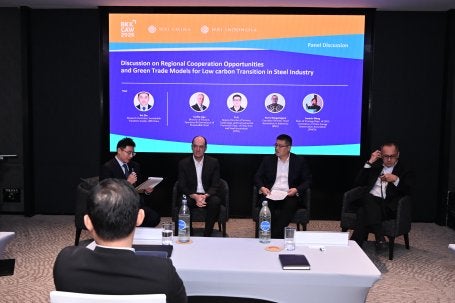
Following the keynote address, Zhu Kai, Research Associate at WRI’s Sustainable Transition Center in Beijing, moderated a panel discussion on the enabling conditions for regional green steel development.
Cyrille Jegu, Director of Finance, Operations & Governance of Responsible Steel, stressed the importance of clearly defining emissions boundaries, accounting methodologies, classification systems and traceability requirements for green steel. A transparent, comprehensive, and credible assessment framework that enables genuine comparability, he said, is essential for building trust and supporting market development.
Li Yu, Deputy Director of Science, Technology and Environmental Protection Dept. of China Iron and Steel Association (CISA), emphasized that environmental product declarations provide an important foundation for quantifying product-level carbon emissions. These declarations can be integrated with classification standards for low-emissions steel. He also encouraged China and Indonesia to expand cooperation on technology, standards, data systems and professional training.
Harry Warganegara, Executive Director of Steel Association in Indonesia (IISIA), said Indonesia focused on strengthening the enabling conditions for green steel through renewable energy investment, green finance and standards cooperation. These efforts could position help the country become as both a regional partner and an industrial hub for the steel transition.
Managing the “Low-Carbon Sunrise” and the “High-Carbon Sunset”
In a second keynote address, Lu Lu, Research Associate at WRI’s Sustainable Transition Center in Beijing, emphasized that steel decarbonization involves much more than upgrading production technologies. It requires a systemic transition encompassing energy systems, industrial structures, employment, supply chains and regional economies. Alongside support for the “low-carbon sunrise” — including low-carbon technologies, infrastructure, investment and market demand — stakeholders must also manage the “high-carbon sunset.” This includes the orderly retirement of emissions-intensive assets, support for affected workers, risks to suppliers and adjustments to local government revenues.
An inclusive transition can generate a triple dividend for the climate, the environment and society. The orderly retirement of high-carbon facilities can deliver sustained emissions reductions while reducing air pollution and improving community environments and public health. Skills training, job creation, social protection and environmental remediation can, in turn, strengthen public understanding of and trust in the transition. Regional cooperation should also reflect countries’ different stages of development and resource endowments. By considering technology, energy, natural resources, employment and social protection together, countries can develop transition pathways suited to their local circumstances.
Following the keynote address, Clorinda Wibowo, Senior Manager for Energy and Sustainable Business at WRI Indonesia, moderated a panel discussion on practical pathways toward an inclusive steel transition.
Dr. Zhang Wei, Deputy Director of the Center for Environmental Planning and Policy Simulation at the Chinese Academy of Environmental Planning under China’s Ministry of Ecology and Environment, observed that Southeast Asian countries generally have fewer institutional buffers, such as state-owned enterprises, to absorb the impacts of industrial restructuring. Greater attention should therefore be paid to how the low-carbon transition and changing patterns of demand could affect employment and public revenue in traditional steel-producing regions. Objectives aligned with a zero-carbon future, together with supporting finance, employment and social protection mechanisms, should be incorporated into the planning of new projects from the outset.
Sun Ruoshui, Environmental Policy Expert at the United Nations Economic and Social Commission for Asia and the Pacific, noted that blast furnace-based steelmaking has significantly greater environmental and health impacts than electric arc furnace production. These impacts are often disproportionately borne by surrounding communities and vulnerable groups, making green steel development an important component of a just transition. Steel production and project planning should therefore strengthen environmental and health disclosures, community participation and cross-sectoral coordination. Countries should also explore a range of transition technologies and business models, coordinate regional scrap collection and trade in advance, and incorporate carbon constraints into decisions concerning investment in and retrofitting of high-carbon assets.
Chen Zun, Senior Advisor for Agora Energiewende’s industrial program in China, presented recent research showing that a hybrid model — combining domestic direct reduced iron capacity with a moderate level of imports — could better support industrial and employment transitions.5 Trade in green iron can harness countries’ comparative advantages in renewable energy and iron ore resources, helping reduce the cost of green steel production.
Somsak Pikkanesuan, Vice Chairman of Steel Industry Club in Federation of Thai Industries (FTI), highlighted persistent challenges facing Southeast Asia’s steel industry. These include limited and costly supplies of scrap steel, renewable electricity and green hydrogen, as well as the absence of widely accepted green steel standards. He called for stronger regional coordination, improved scrap recovery and resource management, and closer policy alignment between the energy and industrial sectors. Countries should also cultivate market demand for green steel while ensuring that decarbonization efforts support industrial competitiveness and employment.
From Regional Consensus to Action
Yuan Min, Energy Program Director at WRI’s Sustainable Transition Center in Beijing, emphasized in the closing remarks that the steel industry’s low-carbon transition must address energy and resource supplies, industrial competitiveness, green trade, employment protection, local development, environmental quality and public health in an integrated manner. New steelmaking capacity should incorporate requirements aligned with zero-carbon goals across the full project life cycle. For existing capacity, transition planning must carefully assess potential impacts on workers, supply chains, local government finances and surrounding communities.
China and Indonesia play strongly complementary roles across the steel value chain. Building on their respective stages of development and resource endowments, the two countries can strengthen cooperation on technology, energy, finance, markets and workforce development. Credible data and aligned standards will be essential to this process. The two countries can also explore differentiated transition pathways and new models of industrial specialization, including trade in green iron.
Going forward, WRI will continue to serve as a bridge among China, Indonesia and other Southeast Asian countries. It will promote dialogue and cooperation on low-carbon steel standards, renewable energy, energy efficiency, green finance, scrap recycling, green iron trade and a just transition. Through locally tailored pilot initiatives, WRI will work with regional partners to translate research findings and shared priorities into implementable and replicable action — helping advance a low-carbon, equitable and inclusive future for Asia’s steel industry.
