

Featured WRI Experts:
Finding Your Way Home in a City Without Sidewalks: Mobility in the Palmerah Village–City Area

This article is part of the Pojok Belajar Rakyat Kota untuk Inisiatif Inklusif Rendah Emisi (PARKIR) Jakarta program, a collaborative research and knowledge archiving initiative involving women, people with disabilities, urban village residents, and young people to identify challenges and opportunities for inclusive and low-carbon mobility. PARKIR is supported by the UK Government through UK PACT (UK Partnering for Accelerated Climate Transitions).
***
City life is often characterized by convenience: lights that never dim, quick access to public transportation, and a constant, fast-paced rhythm. Trains, buses, and other modes of transport carry people from the outskirts to the city center and back. Everything is in motion, with towering buildings serving as a backdrop to daily commutes. However, a stark reality persists: air pollution blankets the city, slowly seeping into the lungs of millions of Jakarta residents.
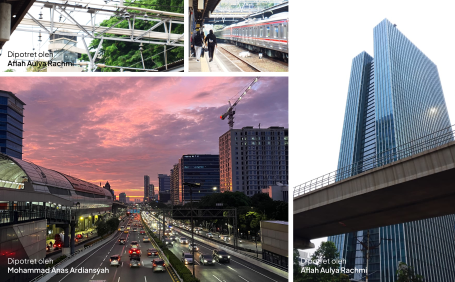
Within this bustling megacity, the Palmerah Sub-District is a critical node of urban mobility. Its strategic location near Palmerah Station and Petamburan Bus Stop appears to provide convenient access to low-emission mobility. However, the reality is starkly different. Palmerah residents continue to rely heavily on private vehicles for daily activities.
“Most residents here use motorcycles and cars,” said Budi, one of the residents of RW 8 Palmerah Sub-District. For many, private vehicles are not a matter of preference, but rather a result of structural coercion stemming from the lack of safe and inclusive public infrastructure.
Village-city space: overcrowded and mobility at risk
Settlements along the Grogol River grow organically, densely, and without clear plot boundaries. Sunlight filters through gaps in the overlapping rooftops. Children play on the riverbank without a designated playground, while narrow alleys and river embankments serve as the backdrop to daily life. This dense spatial structure results in complicated, narrow neighborhood roads. Consequently, vehicles often struggle to navigate these tight spaces, thereby making access to residential areas challenging. Limited areas frequently transform into makeshift storage spots, places for drying clothes, and even parking for private vehicles. Ironically, while proper sidewalks are lacking, parking spaces are almost always available.
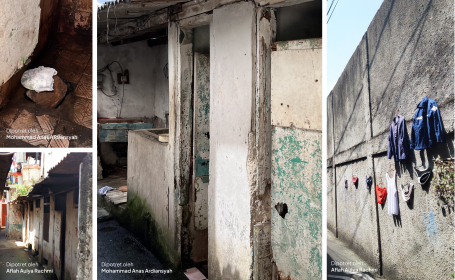
At times, an unpleasant odor wafts from the public toilets wedged between residents' homes. “Earlier, I walked into a small alley and encountered a foul smell; it turned out to be a public toilet, along with the stench from the garbage,” said Yulia, our deaf companion on this journey. These physical constraints deeply influence how Palmerah residents navigate the city.
The twists and turns of the pedestrian path: Portrait of mobility injustice
On a Saturday afternoon on 29 November 2025, we followed three paved and sun-shaded roads. There were no orderly stopping points and no safe paths for pedestrians. Many overlook these details, yet they define how people move. The road bustled only with private vehicles. Not a single turquoise M09 microtrans or blue-and-white microtrans passed by.
The 10 to 15-minute walk to the bus stop may seem short. However, for pedestrians who face impatient drivers' horns, billowing exhaust fumes, and erratic vehicle movements, this distance felt extensive.
“As for me, I’m still healthy and feeling good, thank God, even though it’s far to Palmerah Station; it’s still walkable,” shared Tiwo, a local resident of RW 8 Palmerah Sub-District and one of owners of KTV Palmerah. “I consider walking a form of exercise, but I must admit, the road can be challenging. It's not quite a workout, but it certainly leaves your body sore.”
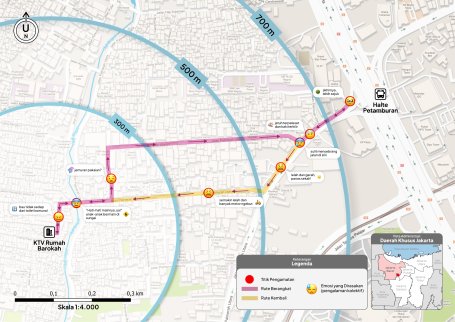
Residents often choose motorcycles or cars to save time and avoid road risks. Although the fastest route to Palmerah Station from the residential area—across a small bridge—appears ideal on a map, it proves unsafe in reality. “To reach Palmerah Station, you can take the bridge up ahead. The path leads straight there,” Budi explained.
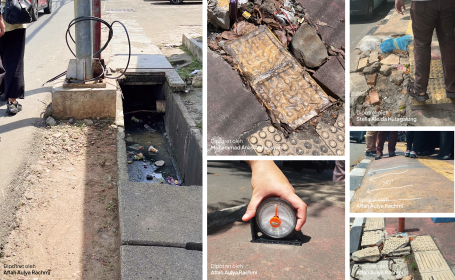
The path from the settlement to the main bus stop highlights the exclusion faced by vulnerable groups, including women, the elderly, persons with disabilities, and children. In some areas, such as Jalan Palmerah Utara, sidewalks are nonexistent, forcing residents to share the road with fast-moving vehicles.
In other segments, sidewalks remain damaged, lack guiding blocks for the visually impaired, and feature sharp slopes of up to 10 degrees, which are hazardous for wheelchair users. Some sidewalks appear to have been constructed solely to satisfy administrative requirements, rather than for practical use. Planted trees fail to provide shade from the hot sun. Instead, their roots create cracks, adding new texture to the pavement.
Yulia paused at the intersection of Jalan Palmerah Utara II and Jalan Raya Palmerah Utara, watching the traffic jam build as vehicles streamed past. A microlet changed lanes abruptly, triggering a chain of persistent horn blasts. Five minutes later, before we could step forward, a minibus repeated the action, and horns blared again in response. Watching the chaos unfold, Yulia expressed her concern: “I’m afraid to cross this road because there’s no zebra crossing. Drivers don’t know I’m deaf since there are no visible indicators of my disability.” This highlights how urban infrastructure is often designed only for perceived 'normal' bodies, neglecting the needs of residents with diverse physical conditions.
This disparity in mobility is particularly pronounced for vulnerable groups with specific needs. Their ability to navigate the city is restricted not by a lack of determination but by an urban environment that fails to accommodate their safe movement.
Without inclusion, the low-emission transition is just talk
The residents of Palmerah rely heavily on private vehicles due to structural issues: a lack of safe sidewalks, insufficient accessible public transportation, narrow residential alleys, and the absence of public spaces that serve vulnerable groups. As Rina, a person with a visual disability, stated, “If development includes everyone with disabilities, the infrastructure will be comfortable for all, not just for those with disabilities.”
Mobility barriers in Palmerah do not affect everyone equally. For some women, walking on narrow, unlit roads can evoke a sense of insecurity. For the elderly, sidewalk slopes and open drains pose a fall hazard. For the visually impaired, missing guiding blocks render every path hazardous. Even for deaf individuals like Yulia, the lack of zebra crossings presents a significant risk because drivers cannot perceive their needs. When urban infrastructure fails to meet the needs of diverse groups, mobility injustices arise, increasingly distancing the dream of an inclusive low-emission transportation transition.
Tiwo offered a simple yet profound perspective: “Many things bring people joy. I feel truly happy fishing or traveling to Rangkasbitung village for just IDR 5,000. But we must still pay attention to persons with disabilities.”
Decarbonization through public transportation will not be achieved if the fundamental challenge of inclusivity remains unaddressed. Low-emission transition efforts must begin with the basics: ensuring that every citizen—including women, children, the elderly, and people with disabilities—can walk, cross, and access public transportation safely. Without these fundamental provisions, the appeal to leave private vehicles will only amount to a call that fails to consider the realities of citizens' lives. Furthermore, decarbonization should strengthen human connections to nature. It must prioritize green pathways as integral components of pedestrian sidewalks, in accordance with the Ministry of Public Works and Public Housing Circular Letter No. 02/SE/M/2018.