

Palmerah at the Junction: Gaps in Access to Mobility

This article is part of the Pojok Belajar Rakyat Kota untuk Inisiatif Inklusif Rendah Emisi (PARKIR) Jakarta program, a collaborative research and knowledge archiving initiative involving women, people with disabilities, urban village residents, and young people to identify challenges and opportunities for inclusive and low-carbon mobility. PARKIR is supported by the UK Government through UK PACT (UK Partnering for Accelerated Climate Transitions).
***
Every built environment reveals its priorities, and Palmerah demonstrates its own through the condition of its roads. At several points, peeling asphalt forms holes that force pedestrians to step sideways to avoid injury. Guiding blocks, intended to guide people with visual disability, stop suddenly or break off more than three times within a range of less than 300 meters. On the sidewalk toward Palmerah Market, motorbikes pass so closely that they eliminate safe space for pedestrians. The sidewalk, intended to be 20 cm wide, narrows to less than half its intended width due to stalls and merchandise encroaching on the path.
For those who walk quickly, these barriers may seem like minor inconveniences. However, for the elderly, people with disabilities, or anyone with limited mobility, every detail is critical. A single uneven surface, a planter placed in the middle of the walkway, or a motorcycle parked without warning can turn a routine journey into a hazardous effort. When access to basic infrastructure is not guaranteed, the city effectively divides those who can move with ease from those who must calculate every step they take.
Marginalized amidst development ambitions
Along the main road, physical development is evident, yet pedestrian access remains an afterthought. Project boards block the sidewalk along without providing alternative routes. In addition, piles of materials, such as sand and stones, protrude into the pedestrian space, forcing pedestrians onto the heavily trafficked road. No temporary barriers are in place, even during aggressive rush-hour traffic. These details highlight how infrastructure projects often treat pedestrian space as an afterthought rather than a priority.
As you approach the Pedestrian Bridge (JPO) near Palmerah Station, accessibility challenges become more obvious. The structure is imposing, yet access is limited to a steep staircase of about 20 steps, with no ramp or lift available. This makes the JPO practically unusable for wheelchair users or the elderly.
Meanwhile, JakLingko signage meant to aid navigation is almost entirely obscured by shop signs and promotional banners. A system designed to facilitate mobility becomes lost in visual chaos.
Narrow space, limited options
Amid these challenging conditions, residents have developed visible ways to adapt. Some hawkers shift their stalls by 30–50 cm to accommodate pedestrian traffic, thereby creating a narrower passage. Motorcyclists use the gaps in the sidewalk as shortcuts when vehicles ahead are stalled in traffic. People communicate through gestures to signal their intention to pass through narrow lanes when there is insufficient space for two-way traffic. These actions reflect community resilience, yet they also highlight a troubling reality: the city depends on residents’ improvisation to compensate for inadequate design.
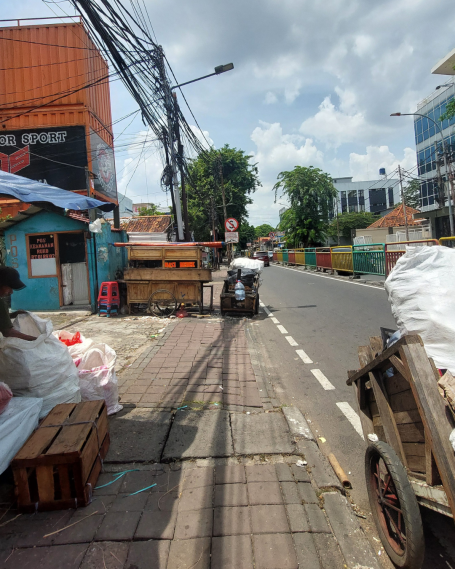
However, not everyone can adapt equally. Minor obstacles may seem insignificant to some, but to the elderly or wheelchair users, they pose formidable barriers. Because cities depend on citizens' flexibility to facilitate mobility, vulnerable populations are most marginalized. Unequal spaces create disparate life experiences, and their effects are felt daily, even over short distances.
Through the Lens of an Elderly Hawker
Amid the hustle and bustle of Palmerah, an elderly hawker transforms the journey into more than just navigating urban space. Nearly a century old, she sits beside her load of chips. Having arrived in Jakarta alone, without family support, she has relied on mobility for years as a means of survival. Every day, she travels from Rawa Belong to Palmerah—a route chosen not for its efficiency, but because it feels short and predictable. His daily travel expenses average IDR 20,000, twice his food budget of IDR 10,000. In her view, safety becomes her most expensive luxury.
Public transportation—like TransJakarta or Mikrotrans—never truly became an option for her. The barrier was not the fare, but the complexity. A system with numerous lines, numbers, and rules felt overwhelming. She cannot always ask for help, and not everyone has the patience to guide her. As a result, she opts for a motorbike taxi or public transport, despite the higher costs, because it allows her to stop near her stall effortlessly. She avoids navigating complex stops, unclear signage, or crowded corridors. For her, mobility is not about convenience—it is about maintaining control and a sense of security.
When asked, “If you could ask the governor for something, what would you say?” she chuckled softly. The answer, though simple, carries deep significance, “Ah, how could someone like me possibly meet the governor?” This statement underscores a stark reality: citizens often feel disconnected from their government. Policy debates feel remote; her needs are immediate: a path without tripping hazards, a route easy to remember, shelter when rain falls suddenly. She remembers being drenched in a heavy downpour—“soaked,” she said, shivering from the cold due to the lack of shelter along his route.
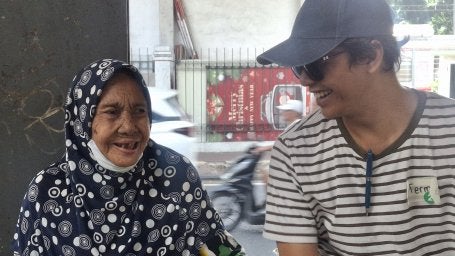
An elderly person who works tirelessly, in a city that doesn't slow down for her.
Her experience personalizes the issue of mobility. She reminds us that urban access is not merely about infrastructure or efficiency; it is about a city’s willingness to protect its most vulnerable. When individuals spend more on travel than on food simply to feel secure, the city should listen carefully. Her experience clearly reveals how the built environment determines who must fight to move and who is privileged enough to pass without a second thought.
A call for feasible and impactful action
A closer look at Palmerah's conditions reveals that mobility issues are not always addressed through large projects or bold policies. Instead, they often stem from small, recurring details: narrowed sidewalks, broken guiding blocks, project materials obstructing paths, and public signage overshadowed by visual clutter.
Improving the situation doesn't require a major revolution. Instead, it calls for attention to simple but impactful changes that directly benefit users of the space:
- Provide a clear, temporary pathway that is fully accessible whenever projects are underway, rather than merely placing “caution” signs when sidewalks are closed.
- Arrange spaces for hawker in a manner that maintains their livelihoods while ensuring the sidewalk functions effectively for pedestrians.
- Install ramps at key connection points, particularly at station entrances, as vertical access should not depend solely on stairs.
- Eliminate visual clutter around public service signage to ensure clear visibility of JakLingko routes and connectivity.
- Restore basic sidewalk standards, particularly in high-traffic areas, ensuring a minimum width of 2 meters free of obstructions.
Small changes like these may seem simple, yet they profoundly determine whether an individual feels safe enough to venture out or is compelled to stay home. A city that protects its citizens pays attention to the smallest details. As a critical junction in Jakarta’s mobility network, Palmerah should be prioritised within the city’s strategic connectivity agenda to improve mobility, accessibility, and inclusive growth.