

The Narrow Alley That Disappeared from the Map: Access Gap and Inclusive Mobility in Palmerah's Dense Settlement

This article is part of the Pojok Belajar Rakyat Kota untuk Inisiatif Inklusif Rendah Emisi (PARKIR) Jakarta program, a collaborative research and knowledge archiving initiative involving women, people with disabilities, urban village residents, and young people to identify challenges and opportunities for inclusive and low-carbon mobility. PARKIR is supported by the UK Government through UK PACT (UK Partnering for Accelerated Climate Transitions)
***
Jakarta's rapid urbanization, sprawling and re-centralization, drives its expanding connectivity. While housing accessibility in the capital remains challenging, the emergence of public transportation networks now facilitates better access to entertainment, social connections, and economic opportunities. This shift is mainly due to the availability of public transportation options that link former suburban areas to the city center, a significant advantage appreciated by commuters from Bodetabek.
However, during our exploration of Jakarta's vibrant spaces, we found an area that, despite being in proximity to the city's core, feels segregated. Palmerah Sub-District, one of the most densely populated areas in West Jakarta1, stands out as a moderate slum2.
The area is traversed by the Grogol River, which, during the 1990s, inundated residential neighborhoods and prompted river normalization efforts3. Following this process, residents received several meters of land, which they converted into homes, thereby creating new alleys. One such alley, situated along the river's edge, serves as our access point to the RW 8 area. Interestingly, this alley is not listed on Google Maps, presenting significant navigation challenges for ride-hailing services. This was particularly evident when a member of our team, Maisty, a wheelchair user, encountered difficulties. On 29 September, the entire team had difficulty precisely identifying appropriate drop-off and pickup locations for Maisty's taxi.
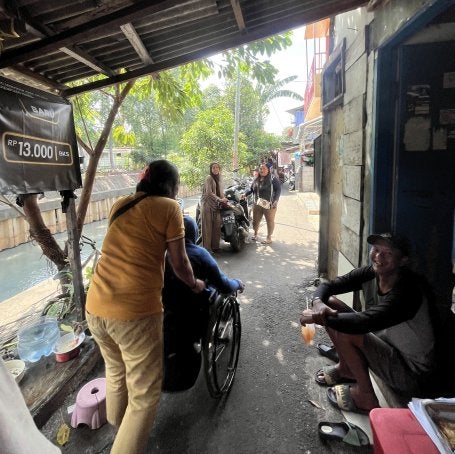
The residential landscape adjacent to the Vertical Land Consolidation (VLC) Rumah Barokah Palmerah, which lies directly in front of the alley, features the Grogol River, restructured during Ahok's administration. After normalization, the riverbanks were transformed into roads and houses for residents.
Photo: Aditya Febrian Tommy
Local residents can access Mikrotrans services within a range of 200–400 meters. Despite this proximity, our colleagues, Iis and Kartiwo, who are residents of RW 8 Palmerah, rarely use public transportation. The circuitous routes, the necessity of having a transportation card, and concerns about safety deter them. As a result, Iis opts for conventional public transport, which costs IDR 5,000 for short distances and IDR10,000 for longer trips, or it depends on motorbike rides provided by family or relatives. For her daily activities within RW 8, walking remains Iis' primary mode of transport. On the other hand, Kartiwo prefers his personal motorbike and is accustomed to traveling longer distances. On weekdays, he commutes to the Pantai Indah Kapuk area for his organizational activities. On weekends, he explores Bogor or the Thousand Islands (Kepulauan Seribu Jakarta) by motorbike.
The narrow alleys, dense housing, food vendors, and local street markets, such as Pasar Pluis, weave together residents' lives. Many destinations are within walking or cycling distance, making it common to see children riding bicycles or walking to visit their peers.
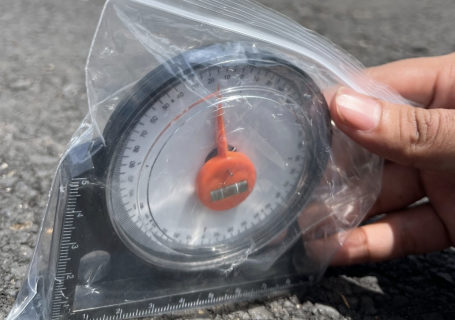
Unfortunately, despite the Palmerah Sub-District's feasible walking or non-motorized accessibility, residents lack adequate road infrastructure. This challenge becomes evident when observing Maisty, a wheelchair user, as she navigates RW 8 Palmerah. The asphalt road is riddled with small stones, holes, and steep speed bumps, creating significant obstacles for her. The route from Pluis Market to the Police Station is an uphill path with a gradient of 15–20 degrees. As a result, Maisty needs assistance from people to push her wheelchair. Had the PARKIR colleagues not accompanied her during the transect walk on 29 November, Maisty typically sought assistance from bystanders. This, however, presents an additional challenge for her to mobile in less populated areas.

We used the web-based platform “Walking Catchment Analyzer” to assess the accessibility of public facilities in the Palmerah Sub-District, with a focus on Rumah Barokah Palmerah, RW 8 (marked as a red diamond). Accessibility observations were conducted at 5-minute intervals and compared to 15-minute intervals to account for weather conditions and their influence on optimal walking duration in Indonesia.
During our visit to public facilities, including the Palmerah Sub-District Health Center (Puskesmas) and SDN 13 Palmerah, we encountered several uphill roads. Notably, while the health center features a guiding block, it lacks a ramp, complicating accessibility. Returning from the Palmerah Sub-District Health Center, we traveled along Jl. Palmerah Barat, which serves as a route for Mikrotrans services Jak.11, Jak.12, Jak.14, and Jak.56. This road reconnects us with Pluis Market and RW 8 Palmerah. The lack of sidewalks made our journey on foot challenging, as we had to navigate alongside fast-moving vehicles. Even where sidewalks exist, they are often occupied by parked vehicles or affected by excavation projects. It was common for us to be honked at, particularly at the corner leading from the gas station to Politeknik Tempo. Afterward, we returned via Pasar Pluis and again observed the condition of the alley leading to SDN 13 Palmerah.
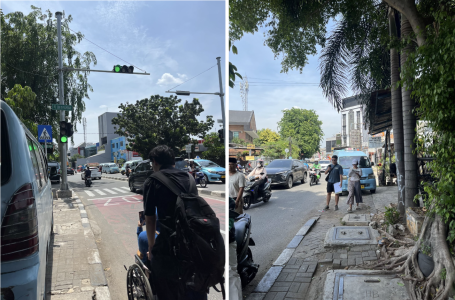
During the trip, Tiwo mentioned that the intersection of the Palmerah Police Station, Pluis Market, and McDonald's Palmerah roads is susceptible to flooding. This occurs because the three connecting roads are downhill, and rivers generally surround the Palmerah Sub-District area. After passing Pluis Market, we re-entered via Gang Palem I. At 11:00 WIB, traders began clearing their stalls and departing from the market area. The day became intensely hot, prompting us to rest in one of the alleys.
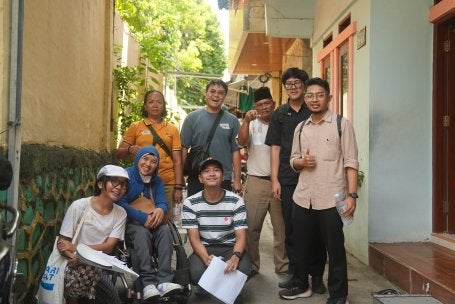
At SDN 13 Palmerah, which also functions as the Redkar Post for RW 8 Palmerah and is Iis's workplace, Maisty required assistance from several individuals to be carried. This was due to the steep steps that constitute the school gate's design.
Beyond mobility challenges, Iis highlighted the critical role of the RW 8 Redkar Post, which addresses frequent fire incidents within the neighborhood and surrounding areas. Redkar RW 8 provides a more effective response than distant district level fire departments. Travel distances, traffic congestion, and traditional firefighting methods often impede access to alley-based settlements. Redkar RW 8's achievements establish it as a pilot project for residential fire extinguishing systems. It is also worth mentioning that Iis is the first and only female member of Redkar RW 8.
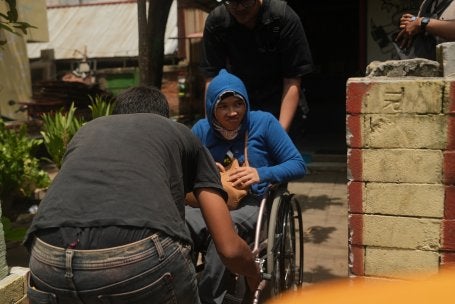
After nearly 1 hour and 15 minutes of travel covering 1.65 kilometers, we returned to Rumah Barokah Palmerah, Kartiwo's home. There, we engaged in discussions and reflections on our shared experiences, accompanied by stories from the past - long before Palmerah was transformed into a densely populated area with complex roads. As we retraced our route, we identified several alleys and roads not represented on the map.
In conclusion, our transect walk to observe mobility and settlement in one of the villages in Central Jakarta highlighted several important points:
- Emphasizing the importance of mapping flood-prone areas and assessing drainage systems, particularly around structures built over waterways
- Reiterating the significant potential for low-emission and active mobility within dense settlements and urban villages, as well as
- The need for planning of integrated and universally accessible mobility routes for residents of urban villages. This approach ensures that the vision of low-emission mobility can be implemented inclusively across all socioeconomic levels.
1Badan Pusat Statistik “Kecamatan Palmerah dalam Angka 2024”
2ArcGIS Online
3Based on the story shared by Kartiwo, a resident of RW 8, Palmerah Sub-District, who has lived there since 1960