

Does Faster Battery Swapping Mean Lower Costs for Electric Trucks?

Ten minutes to swap a battery sounds more appealing than an hour spent charging. For an electric truck operator, that difference could create room for another delivery. But that advantage can quickly narrow when dozens of trucks arrive at once. The exchange itself may take ten minutes, yet the truck could spend considerably longer waiting for an available swapping bay or a fully charged replacement pack.
This is becoming an important for Indonesia as it explores the electrification of freight transport. Operators can choose to charge trucks at depots, use direct current (DC) fast chargers, install megawatt charging systems (MCS), or exchange depleted batteries through battery swapping. Each comes with its own infrastructure requirements,operating constraints, and operating costs.
China offers useful experience. Electric truck deployment there has grown particularly quickly on short, predictable routes serving ports, mining operations, and steel production. These repetitive journeys, especially within industrial hubs, also fabover battery swapping because trucks can regularly return to the same facilities. According to the International Energy Agency (IEA), around 15% of electric trucks sold in China in 2025 were compatible with battery-swapping systems.
Speed, however, does not necessarily translate into lower costs. A study by the International Council on Clean Transportation (ICCT) and the China Automotive Technology and Research Center (CATARC) in Tianjin found that the five-year total cost of ownership of battery-electric trucks using conventional charging was approximately 9% lower than that of diesel trucks. The corresponding figure for battery-swapping truck was around 10%. Yet swapping infrastructure had a longer estimated payback period of 5.8 years, compared with 4.8 years for charging facilities.
The findings point to an important distinction between vehicle economics and infrastructure economics. For Indonesia, choosing how electric trucks replenish their batteries requires looking beyond turnaround time to understand how each option affects freight productivity, infrastructure investment, and the cost of logistics operations.
Charging does not always mean losing working time
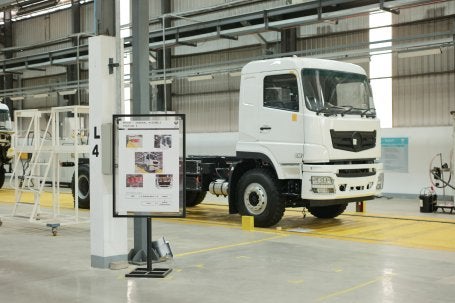
Electric trucks do not always need the fastest available charging technology.
A fleet returning to its depot every evening may have sufficient time to recharge while parked. Regional freight operators may be able to charge during driver breaks or cargo loading and unloading. Mining haulage trucks operating across multiple shifts, by contrast, may have fewer opportunities to stop without interrupting production.
These operating patterns shape the infrastructure required.
Depot charging allows operators to schedule energy replenishment around vehicle availability. DC fast charging can provide additional energy during a journey, while MCS offers substantially higher charging power to shorten sessions for trucks with large battery packs. Battery swapping takes a different approach: a depleted battery pack is exchanged for a charged one, while the removed pack is recharged separately by the station operator.
Consider a truck requiring additional 240 kilowatt-hours (kWh) of energy. At an assumed effective charging power of 240 kilowatts (kW), replenishing that energy would take approximately 60 minutes. At 600 kW, the theoretical charging time falls to 24 minutes. A ten-minute battery swap would save 50 minutes compared with the first option, but only 14 minutes compared with the second.
These are simplified calculations. Actual charging times depend on the vehicle’s power acceptance, battery temperature, state of charge, and charging management. Queuing and travel time to reach a facility many extend the stop further. Not every electric truck can sustain charging at 600 kW.
More importantly, the duration of charging is not always equivalent to lost productivity. If a truck must already spend 45 minutes waiting for cargo to be unloaded, a one-hour charging session may add only 15 minutes to its schedule. Under a different operating pattern, the same hour could mean losing an additionally delivery.
WRI India’s analysis of electric truck charging infrastructure highlights the need to design facilities around heavy-duty vehicle requirements, including grid connections, manoeuvring space, and electrical systems.
For freight operators, the more useful measure is therefore how much productive time each technology can recover, rather than which offers the shortest charging or swapping process.
How do peak arrivals affect electric truck downtime?
A charging or swapping station may perform well when trucks arrive at regular intervals. Its capacity faces a different test when many vehicles need service during the same peak period.
To examine this, the author developed an illustrative simulation using Python. This was a scenario-based modelling exercise prepared for the article, rather than a field assessment of existing charging or swapping stations in Indonesia. The simulation compares DC fast charging, MCS, and battery swapping under the same daily demand: 90 truck visits, each requiring an additional 240 kWh of energy.
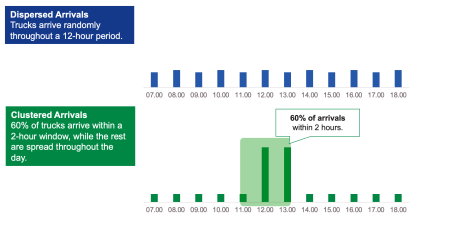
Two arrival patterns are tested. In the first, trucks arrive randomly throughout a 12-hour window. In the second, 54 visits are deliberately assigned to the same two-hour period, illustrated here as 11:00–13:00, while the remaining 36 can occur at any point during the 12 hours.
The concentration assumption is intended to test how facilities respond to a busy period. It is not based on an observed pattern of freight activity in Indonesia. Because the other 36 visits can also occur during the busiest hours, the expected total for the two-hour window is approximately 60 visits, or 67% of the day's traffic.
The model then tracks when each truck arrives, when a charger or swapping bay becomes available, and how long the truck must wait. For battery swapping, it also checks whether a charged replacement battery is ready. Removed packs must be recharged before being returned to the available inventory.
To reduce dependence on one random sequence of arrivals, each station configuration and arrival pattern is tested across 46 independently generated simulation runs. Each run covers seven consecutive days. The first three allow queues and battery inventory conditions to develop; the following four are used to measure performance.
The model then compares a predefined set of station configurations, varying the number of charging ports, swapping bays, internal chargers, and spare batteries. Among configurations meeting the service target, it selects the one with the lowest assumed annualized station cost.
The target is that at least 90% of simulated visits wait no more than 30 minutes before service begins. It applies to queuing time, not the entire charging or swapping session, and does not guarantee that every vehicle will meet the threshold. Figure 2 highlights the simulation results on the matter of station capacity when trucks arrive together.
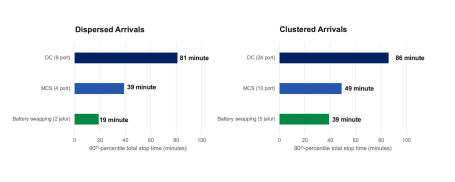
Under dispatch arrivals, the least-cost configurations among those tested and meeting the queuing target require nine DC charging ports, four MCS ports, or two battery-swapping bays.
The corresponding 90th-percentile total stop times are approximately 81 minutes for DC charging, 39 minutes for MCS, and 19 minutes for swapping.
When arrivals become concentrated, substantially more infrastructure is needed. The selected configurations increase to 24 DC charging ports, ten MCS ports, or five swapping bays supported by additional internal chargers and spare batteries.
Even after these adjustments, the 90th-percentile stop times rise to around 86 minutes for DC charging, 49 minutes for MCS, and 39 minutes for swapping.
The simulation does not represent the performance of existing truck-charging or swapping stations in Indonesia. Service times, arrival patterns, and equipment configurations are assumed. It also evaluates a limited set of configurations rather than determining a globally optimal station design.
Nevertheless, the results illustrate an important operational challenge. A ten-minute swapping process tells us little about the total time a truck may spend at a facility during peak demand.
A 2025 study by Wang et al. In IEEE Transactions on Smart Grid similarly found that battery swapping can improve transportation efficiency by reducing vehicle downtime, although it may require larger inventories of batteries. Vehicle scheduling, spare battery availability, and station operations therefore need to be considered together.
Managing when trucks arrive may also reduce the need for additional infrastructure. Better coordination with loading schedules, drive breaks, and fleet dispatch could relieve congestion before operators decide to install more chargers or swapping bays.
The infrastructure costs behind faster battery exchange
Battery swapping can allow fleet operators to separate battery ownership from vehicle ownership through a battery-as-a-service model. Instead of purchasing the battery pack outright, an operator may pay a service provider for access to charged batteries.
This arrangement can lower the upfront investment borne by the truck owner. It does not, however, eliminate the cost of batteries themselves. Spare battery packs must still be purchased, financed, maintained, and eventually replaced.
In the simulated configuration for concentrated arrivals, the swapping station requires 30 spare battery packs, each with a nominal capacity of 450 kWh. Together, they represent an additional 13.5 megawatt-hours (MWh) of battery capacity outside the trucks.
The operator must also invest in swapping equipment, internal chargers, site infrastructure, and grid connections. Swapping offers flexibility to schedule battery recharging separately from truck arrivals, but the electricity still needs to come from the power system.
To examine these costs, the model annualizes station capital expenditure over ten years using a 10% discount rate and adds annual operating and maintenance costs. Spare battery inventories are included in the swapping scenario, even when they are owned by a separate service provider. Figure 3 depicts the simulation results highlighting that a serving peak arrival comes at a cost.
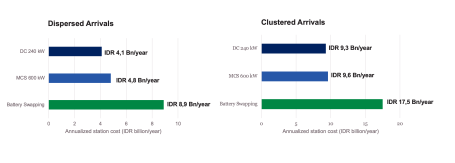
Under dispersed arrivals, estimated annualized station costs are approximately IDR 4.1 billion for DC charging, IDR 4.8 billion for MCS, and IDR 8.9 billion for swapping.
With concentrated arrivals, the cots rise to around IDR 9.3 billion, IDR 9.6 billion, and IDR 17.5 billion per year, respectively.
These estimates are based on hypothetical equipment and infrastructure prices, rather than supplier quotation or actual procurement costs in Indonesia. They also excluded several components required for a full vehicle-and-infrastructure total cost assessment.
Even so, the comparison demonstrates the potential cost of providing reliable service when many vehicles arrive during the same period.
The additional annualized cost of swapping relative to charging must be weighed against the economic value of the time it saves.
Under the concentrated-arrival scenario, swapping reduces average stop time by approximately 49 minutes per visit compared with DC charging, but only around 14 minutes compared with MCS. These are differences in average simulated stop times, rather than differences between the 90th-percentile values displayed in Figure 2.
Assuming every minute recovered can be use productively, the model estimates that swapping would require a net value of recovered operating time of approximately IDR 368,000 per hour to offset its additional station costs relative to DC charging. Against MCS, the threshold increases to approximately IDR 1.25 million per hour.
These thresholds are mathematical results from an illustrative scenario, not estimates of Indonesian freight operators’ actual earnings or a recommended benchmark for investment.
Additional operating time may not translate into another delivery of freight availability, driver schedules, costumer requirements, or road access remain limiting factors. Moreover, the economics can change considerably with battery prices, station equipment costs, or the charging power that vehicles can sustain in practice.
Research by Zhu et al (2023) in eTransportation uses an integrated vehicle-station cost model expressed per tonne-kilometre to compare different energy replenishment methods for heavy-duty electric trucks. Their findings show that station utilization and operating conditions play important roles in determining the most economical option.
For Indonesia, this suggests that infrastructure investment should be evaluated alongside vehicle operations and freight demand, rather than treating charging and swapping stations as isolated assets.
Where should Indonesia test battery swapping?
Indonesia is beginning to accumulate practical experience with electric freight operations.
In its article Truk Listrik: Sekadar Elektrifikasi atau Game Changer?, WRI Indonesia examines the experience of Ever Shine and KALISTA along the Balaraja-Bandung corridor. The case illustrates how charging can be integrated into freight operations and how a fleet-as-a-service model can help address financial and operational barriers to electrification.
Such experience provides useful evidence, but freight operations across Indonesia vary considerably.
Distribution fleets with predictable routes and long parking periods may find depot charging sufficient. Regional freight operators may benefit from DC fast charging or MCS when charging sessions can overlap with rest stops or cargo-handling activities.
Battery swapping deserves closer examination in intensive, geographically concentrated operations with limited stopping time, such as certain mining haulage routes or industrial logistics clusters. These activities may provide sufficient vehicle throughput to support shared swapping infrastructure.
However, the potential depends on station utilization, compatibility across vehicle and battery designs, grid capacity, and the additional costs that operators can realistically bear.
The assessment also needs to move beyond station costs. A more representative measure for freight operators is the total cost per tonne-kilometre of goods transported, accounting for payload capacity, vehicle reliability, downtime, and the combined costs of vehicles and infrastructure.
China’s experience offers a reason for Indonesia to test battery swapping, but not enough evidence to make it the default solution for heavy-duty freight electrification. Early trials would be more useful if focused on operations with repetitive routes, high vehicle utilization, and tight turnaround requirements, while evaluating depot charging and high-power charging under comparable service standards.
Such trials should examine how queues develop during peak periods, how many spare battery packs are needed, and whether shorter stops lead to higher freight throughput. Station utilization, grid connection requirements, and costs per tonne-kilometre would provide a stronger basis for investment decisions than advertised charging or swapping speeds alone.
The results could help government agencies and industry players identify suitable investment locations, assess interoperability requirements, and design support measures around demonstrated operational needs. Expanding infrastructure before those needs are established risks tying up capital in facilities that may remain underused.
The central consideration is how reliably and economically each option can move goods. A faster battery exchange is valuable when it improves the wider logistics operation enough to justify its additional cost.
References
International Council on Clean Transportation (ICCT) & China Automotive Technology and Research Center (CATARC). (2025). Electrifying On-road Freight: A Case Study of Drayage Trucks in the City of Tianjin, China.
International Energy Agency (IEA). (2026). Global EV Outlook 2026: Trends in Other EV Modes.
International Council on Clean Transportation (ICCT). (2025). The Cost of Energizing Medium- and Heavy-duty Truck Charging Facilities in the United States.
Kundu, A., Polisetty, M., & Patki, S. (2026). Electrifying India's Highways: Infrastructure Requirements for E-Truck Charging. WRI India.
Patki, S., et al. (2025). Financial Impact Assessment for Zero-Emission Trucks (Fi-ZET). WRI India.
Wang, R., Martinez, A., Allybokus, Z., Zeng, W., Obrecht, N., & Moura, S. (2025). Electrifying Heavy-Duty Trucks: Battery-Swapping Versus Fast Charging. IEEE Transactions on Smart Grid, 16(5), 3989–4003.
WRI Indonesia. (2026). Truk Listrik: Sekadar Elektrifikasi atau Game Changer?.
Zhu, F., Li, L., Li, Y., Li, K., Lu, L., Han, X., Du, J., & Ouyang, M. (2023). Does the Battery Swapping Energy Supply Mode Have Better Economic Potential for Electric Heavy-duty Trucks?. eTransportation, 15, 100215.