

Featured WRI Experts:
Indonesia Has Submitted Its Second NDC. Are Its Climate Targets More Ambitious?
Explore more:
climate agreement

Image by
Yulia Agnis on Unsplash
After a prolonged wait, the Indonesian government has submitted its Second Nationally Determined Contribution (SNDC) to the United Nations Framework Convention on Climate Change (UNFCCC). Why does Indonesia need to submit its SNDC? And how does it differ from the previous NDC?
What is NDC, and why is Indonesia updating its NDC?
Nationally Determined Contributions (NDCs) lay out how each country will contribute to the global temperature goals outlined under the Paris Agreement. They detail countries' plans to limit global warming to 1.5°C and include measures to build resilience to climate impacts.
Indonesia first submitted its NDC to the UNFCCC in 2015, which was subsequently updated into an Enhanced NDC in 2022. The Enhanced NDC aimed to reduce greenhouse gas (GHG) emissions by 31.89% unconditionally and 43.20% with international support by 2030, compared to the business-as-usual scenario in 2010.

This update aligns with the mandate of the Paris Agreement and Decision 1/CP.21 of the UNFCCC, which requires countries to update their NDCs every five years. Indonesia is now presenting its Second NDC, incorporating adjustments based on insights from the first Global Stocktake (GST), the Long-Term Low Carbon Development Strategy and Climate Resilience (LTS-LCCR 2050), and Indonesia's developmental vision articulated in Asta Cita and the national development plan (RPJMN 2025-2029 and RPJPN 2025-2045). Through the SNDC, Indonesia reaffirms its commitment to a consistent climate transition towards Net Zero Emissions by 2060 or sooner, balancing climate ambition with economic growth and national development priorities.
What is Indonesia’s updated commitment in the SNDC?
Compared with the Enhanced NDC (ENDC), the SNDC introduces several important updates. These include adjustments to the implementation period and the base year reference, an expanded scope covering additional GHG and subsectors, refined emission-reduction target scenarios, and a more comprehensive discussion of the just transition.

What Do the Updated Scenarios and Targets Mean?
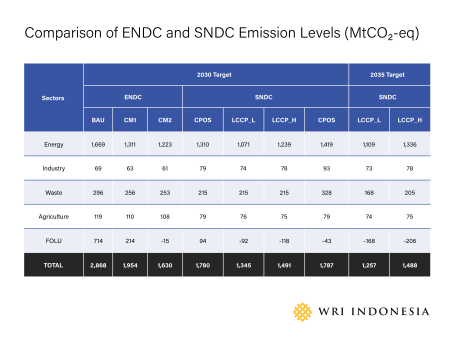
The SNDC has updated the base year reference from the 2010 business-as-usual scenario of 1,334 MtCO₂-eq to the actual emissions level of 1,145 MtCO₂-eq recorded in 2019. In addition, Indonesia's emission reduction target has shifted from percentage-based targets of 31.89% and 43.20% for 2030 to a new absolute emissions target for 2035. This shift reflects a more modern methodology aligned with Dec.1/CMA.5 and consistent with UNFCCC transparency standards. It also presents a more representative picture of Indonesia's emissions conditions prior to the COVID-19 pandemic.
The SNDC also introduces three new scenarios, replacing the domestic and international scenarios used in the ENDC. These three scenarios include the Current Policy Scenario (CPOS), which focuses on domestic action, and two Low Carbon Compatible with Paris Agreement (LCCP) scenarios, which combine domestic action and international support to achieve the 1.5°C pathway. All three scenarios are based on the following economic growth assumptions:
• CPOS: moderate economic growth (6.0% by 2030; 6.7% by 2035).
• LCCP_Low: moderate economic growth (6.0% by 2030; 6.7% by 2035).
• LCCP_High: high economic growth (7.0% by 2030; 8.3% by 2035).
Projection models indicate that both LCCP scenarios are expected to peak in emissions by 2030 before transitioning to a net sink by 2060. However, achieving the LCCP scenario is highly contingent on securing international funding. The SNDC emphasizes that international support is a critical component in realizing these national climate goals, while underscoring the need for decarbonization efforts aligned with the projected economic growth of up to 8%.

The SNDC reflects a significant increase in ambition when compared to the previous NDC. In 2030, absolute emissions in the LCCP_Low and LCCP_High scenarios are projected to be 8% and 17.5% lower, respectively, than the CM2 scenario presented in the ENDC. By 2035, emissions are expected to decrease further, reaching 1,488 MtCO₂e (LCCP_Low) and 1,257 MtCO₂-eq (LCCP_High).
Accelerating a Just Transition, Strengthening Blue Carbon, and Advancing the Adaptation Agenda
For the first time, the SNDC includes a dedicated sub-chapter on a just transition. This sub-chapter affirms Indonesia's commitment to a just and inclusive energy transition and low-carbon development. It addresses transition challenges, ensures the future of workers, develops a low-emission economy that creates jobs, increases workforce capacity by prioritizing equality and vulnerable groups, and strengthens participatory dialogue on work, social protection, labor standards, and worker welfare.
The SNDC also highlights the potential of blue carbon ecosystems, such as mangroves and seagrass, for climate mitigation. To maximize this potential, the Ministry of Maritime Affairs and Fisheries is developing Ocean Accounting for marine and coastal ecosystems through SIDAKO. It also updates seagrass maps and methodologies to support their integration into future mitigation actions and NDC commitments.
From a climate change adaptation perspective, the SNDC also emphasizes actions with co-benefits in mitigation. The government assesses research needs and gaps related to loss and damage, including slow-onset events and extreme disasters. In addition, it strengthens local community resilience through Program Kampung Iklim (ProKlim).
Funding Support Becomes Increasingly Crucial
Funding support grows increasingly critical in the SNDC. Financing needs significantly increase from the Second Biennial Update Report (BUR) estimate of approximately USD 247 billion for the 2018–2030 period to USD 472.6 billion for the 2030–2035 period. This applies to the energy, agriculture, FOLU (forest & other land-use), and waste sectors (excluding the industrial sector). To address this challenge, the SNDC affirms the government's commitment to expanding international cooperation and strengthening national climate finance by:
• Presidential Regulation No. 110/2025 as the basis for implementing a carbon market mechanism.
• Strengthening the Indonesian Environment Fund (IEF) to effectively mobilize and manage climate funds from diverse sources.
• Allocating approximately USD 36.2 billion (Rp 610.1 trillion) during the period of 2016–2023 for climate-related programs, averaging Rp 76.3 trillion per year.
• Introducing innovative fiscal instruments, including green bonds, tax incentives, and blended finance mechanisms.
What's the Next Step?
The SNDC demonstrates greater ambition than the previous NDC, with several significant updates. Therefore, Indonesia's SNDC document demands far more concrete action from various stakeholders, including the government, the private sector, and local communities. This action requires a series of policies, regulations, and appropriate climate approaches to achieve the zero-emission target by 2060 or sooner. These efforts encompass strengthening cross-sector planning and budgeting integration, increasing capacity, developing detailed implementation and monitoring guidelines, improving data, monitoring, and reporting systems, and mobilizing financing. Through these improvements, the SNDC provides a strong foundation for Indonesia to realize a transformation toward equitable, climate-resilient, low-carbon development.