Featured WRI Experts:
Explore more:
Ocean



Ahead of World Oceans Day on June 8, 2026.
***
It is undeniable that Indonesia’s aquaculture sector—particularly shrimp aquaculture—is a major a significant source of economic value for the country. Farmed shrimp production has increased exponentially, rising from 150,000 tonnes in 2000 to almost one million tonnes in 2021. Since 2016, Indonesia has consistently ranked as the world’s fourth-largest exporter of frozen shrimp, trailing India, Ecuador, and Vietnam with an export share of around 6–7 percent.
Yet this growth narrative tells only part of the story – especially when viewed through a GEDSI (gender equality, disability, and social inclusion) lens, which emphasizes who benefits, who is excluded, and whose labor and risks remain invisible. Despite the sector’s scale, the people who sustain the industry every day remain unseen in both policy and practice. Women, for instance, constitute 42 percent of aquaculture workers, yet their roles and agency remain largely invisible in policy narratives—even in high-value sectors such as shrimp aquaculture. Youth in coastal and aquaculture communities also remain pushed to the margins. Many young people work in shrimp aquaculture in downstream activities – feeding, monitoring water quality, net cleaning – yet they are rarely recognized as formal workers. Their wages are often disproportionate to the heavy labor they perform and they are frequently sidelined in decision-making processes.
This brings us back to a crucial question: who actually benefits from this growth, and why do so many of its key actors remain invisible? This invisibility also raises a broader question about what “sustainability” truly entails. Growth alone cannot be considered sustainable if it excludes the very people who keep the system running. Inclusivity—through GEDSI perspectives—must be part of the equation.
According to the FAO (2016), aquaculture has the potential to address global food demand by increasing food availability, enhancing nutrition and food security, while at the same time supporting job creation and income. Despite positive social and human benefits, they do not outweigh the well-documented negative impacts associated with shrimp aquaculture. The intensification of shrimp farming, historically driven by rapid land expansion and weak regulatory oversight, place severe pressure on the environment – through habitat loss, waste-driven pollution, and broader ecological disruption. Research also shows that intensive shrimp ponds expansion often leads to displacement of local livelihood.
These ecological pressures often translate into social marginalization. For example, as shrimp ponds expand into coastal landscapes, local livelihoods are displaced, particularly where communities depend on mangrove ecosystems for subsistence and income. Women are disproportionately affected, as they balance childcare with collecting shellfish and crabs from mangroves to support household income; when mangrove ecosystems are degraded by effluent pollution from shrimp farming, these vital sources of food and income disappear, leaving families economically and nutritionally vulnerable.
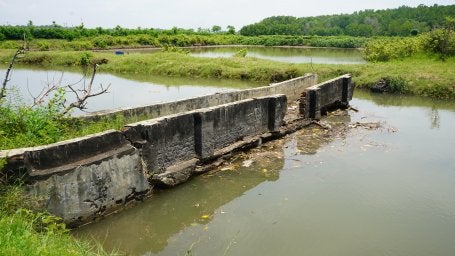
From a broader social standpoint, the intensive shrimp aquaculture tends to overlook critical social and human-rights dimensions, including workers’ rights, equitable distribution of benefits, and meaningful access and participation for local communities, particularly vulnerable groups such as women, youth, and Indigenous peoples, in its value chains. These issues are reflected in several documented cases. Studies have documented cases where large shrimp farms forcibly dispossessed local landowners, often involving violence, while other research has highlighted the vulnerability of small-scale shrimp farmers, who are excluded from export markets and inadequate in capital to withstand natural disasters.
These ecological, socio-economic, and human rights concerns are not isolated. Rather, they reflect deeper structural shortcomings in how the sector is governed. Limited investment in social and gender capacities, along with the tendency to sideline social and cultural considerations in favor of trade and technology priorities, also reinforces these shortcomings. Institutional and sectoral barriers make these gaps even harder to address. Together, these dynamics have resulted in weak and uneven outcomes in aquaculture and illustrate how current aquaculture models often structurally reproduce unequal power relations and deepen vulnerability. This underscores why GEDSI considerations must not sit at the periphery but instead form an integral part of the sector. Without gender-responsive, inclusive, and socially attuned governance, shrimp aquaculture systems risk reproducing and deepening existing inequities.
Examples from our research demonstrate how these inequities manifest in everyday practice. Women and youth often uphold household resilience by filling income gaps during climate-driven production losses, yet they remain unrecognised and excluded from decision-making, reflecting persistent barriers to their meaningful participation in shrimp aquaculture.
Therefore, it is important to recognize that GEDSI integration is not only a moral imperative but also a strategic one. Inclusive systems drive for more effective resource governance, support more resilient livelihoods, and enhance communities’ capacity to adapt to climate change.
For WRI and the AQUADAPT Indonesia consortium, this understanding carries important implications for how we design, engage, and implement climate-smart shrimp aquaculture interventions. This is why, within LEAPS—a collaborative research and action program focused on climate change adaptation in coastal aquaculture, integrated with sustainable shrimp farming practices, mangrove ecosystem restoration, and socio-economic empowerment of coastal communities—we place strong emphasis on GEDSI integration within Climate-Smart Shrimp Aquaculture.
We recognise that conventional “climate-smart” approaches tend to be technocratic and oriented towards production targets or technical efficiency. To be effective and equitable, these approaches must be complemented by gender-responsive planning, inclusive decision-making, and the redistribution of benefits and labour. Our emphasis on a GEDSI approach is grounded in extensive literature showing that technological adaptation often fails to include women because it does not align with their social contexts; adaptation programmes frequently do not reach the most vulnerable groups; and technical innovations alone rarely address or transform underlying structural inequalities.
These patterns were also evident in our fieldwork. Inequality in shrimp aquaculture is not abstract––it shapes everyday practices. For example, although all the small-scale farmers in our study were men, women played integral roles in logistics, post-harvest work, and supporting household income, yet they remained excluded from formal decision-making. Youth participation is similarly limited; only a small fraction of farmers was under 30, reflecting that younger people have limited pathways into the sector. Climate-related production disruptions intensified these disparities, as the financial and daily-life pressures affect men, women, and young people differently. These insights highlight why GEDSI must guide not only our analysis of climate-smart aquaculture, but also the design and implementation of our climate-smart shrimp aquaculture work.
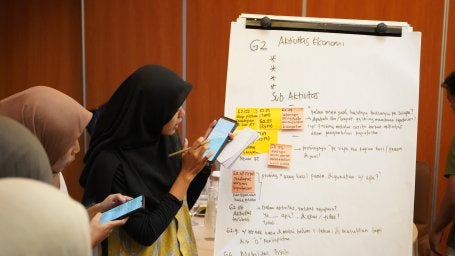
Applying a GEDSI perspective has enabled us to design stronger programmes and activities by uncovering gendered power dynamics and the underlying root causes of inequality within shrimp aquaculture in our pilot locations. Moreover, GEDSI approaches have supported us in building collaborative processes with local communities—co-analyzing solutions for climate-smart shrimp aquaculture, encourage more inclusive participation with vulnerable communities (e.g., women and youth), integrating accessible nature-based practices, and co-implementing interventions. In doing so, GEDSI ensures that adaptation efforts do not only improve technical performance but also advance fair and meaningful participation and strengthens safeguarding measures for local communities.
In addition, the use of a GEDSI approach has also encouraged institutional changes among consortium partners. Through training and workshops, GEDSI-sensitive approaches have strengthened organizational capacity and ensured that gender equity is prioritized across all aspects of the project. This shift also reminds us that meaningful change needs to happen not only with communities, but within the organizations that design and implement climate-smart aquaculture interventions.
The use of a GEDSI approach becomes crucial if we genuinely aim to bring transformative changes to the community. This approach is not only relevant for project implementation but can also be adapted to push for a more inclusive blue economy or a just transition in aquaculture. One concrete example is the implementation of climate-smart aquaculture in Bangladesh using a GEDSI lens. They highlighted increases in women’s household decision-making, as well as their improved ability to contribute to household food security and income. These shifts in decision-making were linked by participants to women’s increased practical knowledge and skills—such as on climate-smart species and best management practices—and their direct access to and control over key productive assets (like fingerlings). Example like these demonstrate that when GEDSI is centered and applied, the benefits extend far beyond individual projects. It helps to reshape the systems, redistribute power, and move aquaculture closer to genuine inclusion.
Hence, GEDSI is not an add-on. It is the foundation for achieving aquaculture systems that are equitable and climate-resilient. Integrating GEDSI principles is essential to sustainability itself. Therefore, we must center those who have long been pushed to the margins. Women, youth, and IPLCs hold critical knowledge, skills, and lived experiences that make shrimp aquaculture possible and resilient. This is not only a matter of justice, but also of effectiveness. To translate this into practice, we strongly urge policymakers, researchers, and practitioners to embed GEDSI frameworks within aquaculture governance.
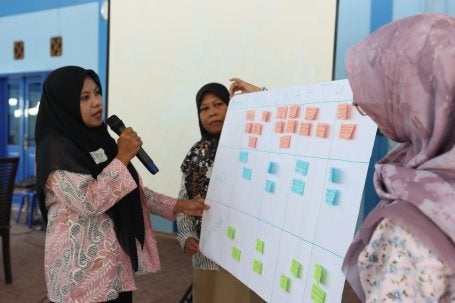
We exemplify this by strengthening capacity building and gender-responsive approaches within aquaculture programs (e.g., recognizing and highlighting women’s invisible care work and labor, and providing gender-responsive financial literacy or budgeting support for youth to access aquaculture); ensuring meaningful GEDSI representation (e.g., women, youth, persons with disabilities, etc.) within local institutions to enhance decision-making power among aquaculture stakeholders (e.g., encouraging the participation of women and youth in Kelompok Usaha Bersama (KUB), or developing shrimp aquaculture cooperatives centered on women’s or youth participation); and lastly, developing clear measurement frameworks to monitor GEDSI inclusion across policies, regulations, and organizational practices. Through these approaches, GEDSI can move beyond theoretical concepts and drive a more just, inclusive, and sustainable future for Indonesia’s aquaculture sector.[]
