

Explore more:
metana
Press Release
Strengthening Methane Emissions Data, WRI Indonesia Advances Data-Driven and Sustainable Waste Management
Key Takeaways
-
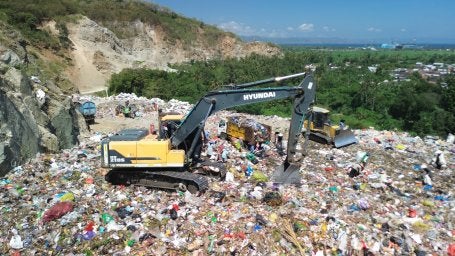
Around 96% of Indonesia’s 511 landfills are still using open dumping systems, with organic waste accounting for the largest share (around 52%). Organic waste generates significant methane emissions and increases fire risk.
-
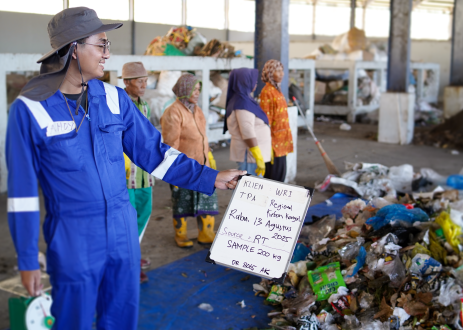
WRI Indonesia conducted research at five landfills in Solok, Surabaya, Balikpapan, Mataram, and Gorontalo to assess waste characteristics, and at two landfills in Surabaya and Bogor using drone and methane sensor technology.
-
SMART Waste Indonesia proposes applying the IPCC Tier 2 approach to strengthen the quality of national waste data in SIPSN, using local activity data and country-specific emission factors, while developing the Methane Emission Toolbox (MET) application platform.
Jakarta, 19 August 2026 – WRI Indonesia has handed over the findings of its study on methane emissions from the waste sector to the Ministry of Environment/Environmental Control Agency. Through the SMART Waste Indonesia initiative, supported by the Global Methane Hub, research conducted since 2024 shows the importance of improving waste data quality, emissions inventory methodologies, and methane emissions monitoring and measurement as part of efforts to mitigate greenhouse gas (GHG) emissions.
As a country committed to the Global Methane Pledge, Indonesia continues to strengthen efforts to reduce global methane emissions by 30% by 2030, including through the waste sector, a national priority area. The SMART Waste Indonesia project supports government and stakeholder capacity-building to measure, monitor, verify, and report methane emissions from the waste sector. It also promotes the adoption of more accurate data management and emissions measurement systems to support the development of mitigation policies and strategies.
Data from the Ministry of Environment’s National Waste Management Information System (SIPSN) show that, of the approximately 511 landfills, an estimated 96% still operate under open dumping systems, with organic waste accounting for the largest share of household waste. In 2025 alone, Indonesia generated approximately 144,000 tonnes of waste per day, while only around 25% was recorded as managed, leaving significant potential for methane emissions. However, waste data and emissions inventories still face limitations, including reliance on estimation methodologies and monitoring systems that have yet to be fully optimised.
SMART Waste Indonesia has proposed calculating methane emissions inventories using the IPCC (Intergovernmental Panel on Climate Change) Tier 2 methodology, using improved waste composition and local activity data combined with more accurate country-specific emission factors. This proposed Tier 2 is supported by three key activities: waste composition surveys, methane emissions monitoring, and developing the Methane Emission Toolbox (MET), a platform designed to strengthen the quality of national waste data in SIPSN (National Waste Management Information System).
A survey of five landfills in 2025, representing a range of landfill contexts in Indonesia — small cities, large cities, medium-sized cities, metropolitan areas and regional landfills — in Solok, Surabaya, Balikpapan, Mataram and Gorontalo, found that 52.02% of the waste accumulated at the surveyed sites was still organic waste, while another 12.83% was paper waste. Both types of waste generate methane as they decompose under oxygen-limited conditions, making them ongoing sources of emissions and increasing fire risk.
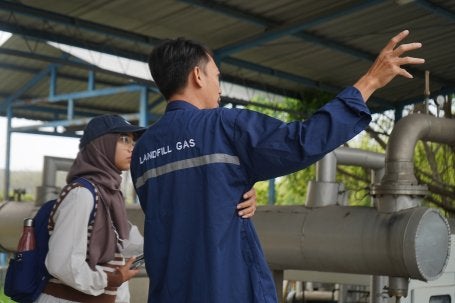
In addition to the waste composition surveys, the project monitored methane emissions at Benowo Landfill in Surabaya and Galuga Landfill in Bogor using drone and methane sensor technology. The process involved local governments through coordination and dialogue to develop policy recommendations and support the strengthening of the national emissions inventory system.
Haruki Agustina, Director of Climate Change Mitigation at the Ministry of Environment/Environmental Control Agency (KLH/BPLH), representing Minister of Environment/Head of BPLH Mohammad Jumhur Hidayat, said, “Waste management plays an important role in Indonesia’s low-emission development and climate change agenda. The Government of Indonesia continues to encourage the waste sector to contribute to the national GHG emissions reduction target, including by developing a waste-sector roadmap. In this context, the SMART Waste Indonesia initiative, particularly through strengthening methane emissions measurement methods and MRV systems, is expected to support the provision of more accurate data as a basis for developing policies and mitigation actions aligned with national climate policies.”
Nirarta Samadhi, Country Director of WRI Indonesia, said, “WRI’s SMART Waste Indonesia initiative demonstrates that methane mitigation cannot only begin once waste has reached the landfill. Efforts need to start with waste reduction and source segregation, the diversion and treatment of organic waste, and improvements in landfill management and methane gas utilisation. WRI Indonesia promotes stronger monitoring, reporting, and verification (MRV) capacities, as well as improved waste data quality to support targeted and effective methane mitigation actions.
Strengthening data and MRV systems needs to go hand in hand with a paradigm shift in waste management, from the collect–transport–dispose approach towards waste management at source. This includes preventing and reducing waste generation, source segregation, increasing recycling and organic waste treatment, and reducing the amount of waste that ends up in landfills.”
Manjyot Ahluwalia, Regional Lead for Asia at the Global Methane Hub, also expressed her appreciation, saying, “Indonesia is demonstrating to Global South countries that addressing methane emissions from the waste sector is possible through transparent monitoring and reporting, data-driven waste management, and climate-responsive waste management, both at the national and subnational levels. The SMART Waste Indonesia initiative demonstrates how science, technology, data and institutional collaboration can help strengthen the evidence base for decision-making in the waste sector.”
With increasingly integrated monitoring systems, the Government of Indonesia can identify emission sources and priority areas, determine the most effective mitigation interventions, and direct investment toward waste management facilities and efforts that deliver the greatest emissions-reduction benefits. Strengthening MRV and data utilisation through SMART Waste Indonesia can therefore support more measurable, evidence-based implementation of Zero Waste Zero Emission (ZWZE), while ensuring methane emissions reductions are monitored, reported, and verified.
About WRI Indonesia
WRI Indonesia was established in Indonesia as Yayasan Institut Sumber Daya Dunia. WRI Indonesia is an independent research organisation dedicated to contributing to inclusive and sustainable socio-economic development in Indonesia. Our work focuses on five portfolios: forests, climate, energy, cities, transport and oceans. We turn big ideas into action at the nexus of the environment, economic opportunity and human well-being. For more information, please visit https://wri-indonesia.org/id.
About the Project
SMART Waste Indonesia (Strengthening Methane Action through Reliable Tracking in Waste Sector) is a WRI Indonesia project supported by the Global Methane Hub and runs from September 2024 to August 2026. The project aims to strengthen methane emissions measurement, MRV systems, and stakeholder capacity to develop methane emissions reduction strategies and actions through a circular economy approach.
Primary Contact

Projects
SMART WASTE Indonesia
Part of Iklim