

Explore more:
cities
Bajik Birittana Tasambajik Rupanna Gauka: Inclusivity Hasn’t Reached Barrang Lompo
The mobility experience of Barrang Lompo island residents shows that accessibility and inclusiveness in Makassar are still not fully available for all people, especially vulnerable groups and island communities.

Image by
Nur Rihadatul Aisyah/PARKIR Makassar
Key Takeaways
-
The experience of traveling to Barrang Lompo shows that access to sea transportation for people with disabilities is still not inclusive.
-
The mobility of island communities is highly dependent on natural conditions, creating social and economic vulnerabilities in daily life.
-
Public infrastructure and services in the archipelagic area still need to be improved, so that the right to inclusive mobility can be experienced by the entire community.
This article is part of the Pojok Belajar Rakyat Kota untuk Inisiatif Inklusif Rendah Emisi (PARKIR) Makassar program, a collaborative research and knowledge archiving initiative involving women, people with disabilities, urban village residents, and young people to identify challenges and opportunities for inclusive and low-carbon mobility. PARKIR is supported by the UK Government through UK PACT (UK Partnering for Accelerated Climate Transitions).
***
Makassar is often touted as an inclusive city—open, welcoming, and accommodating to all.It is a compelling narrative, especially for a coastal city that has long served as a melting pot for diverse people, interests, and travel.Yet, a simple question arises when we set out to move across it: inclusive to whom and to what extent?
On the 23rd of April, we began our journey to Barrang Lompo Island from Kayu Bangkoa Pier, a vital link between mainland Makassar and its surrounding islands. It was here that the true meaning of inclusivity was put to the test—not as a textbook concept, but as a lived experience. This mirrors the expression “Bajik Birittana Tasambajik Rupanna Gauka,” which describes how something sounds good in a story but fails to align with reality. In this context, the community's concrete mobility realities test the claim of urban inclusivity rather than leaving it as a mere ideal.
Stepping with Assistance, Not Independence
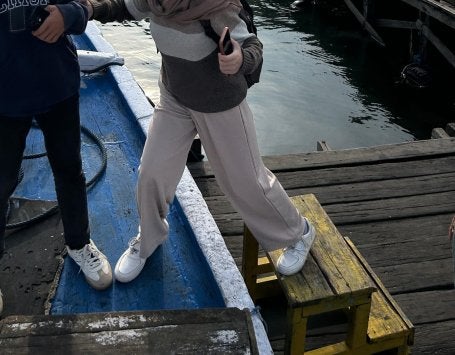
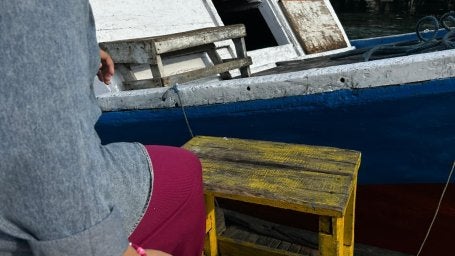
Photo: Junaidi/PARKIR Makassar
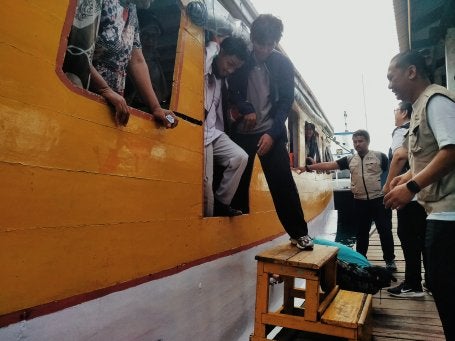
At Kayu Bangkoa Pier, the journey to Barrang Lompo does not begin with equal steps. One of our team members, Fajrin, a person with visual disability, had difficulties walking around the pier and boarding the boat. Without adequate ramps and accessible boat docking systems, he relied entirely on the assistance of others to climb onto the boat's deck.
In that narrow and uneven space, small differences such as the distance between steps or the height difference between the pier and the boat become formidable barriers. Some of us stepped into the boat immediately, while others paused for a moment to adjust their positions or waited for assistance from those around them. This reflects the cultural value of assitulung—the tradition of mutual assistance among island communities—yet it also lays bare how access has not become a given right. Independent mobility for all citizens, regardless of their physical ability, remains a key pillar of an inclusive city that the pier still lacked.
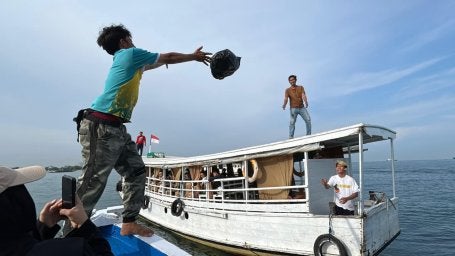
Photo: Junaidi/PARKIR Makassar
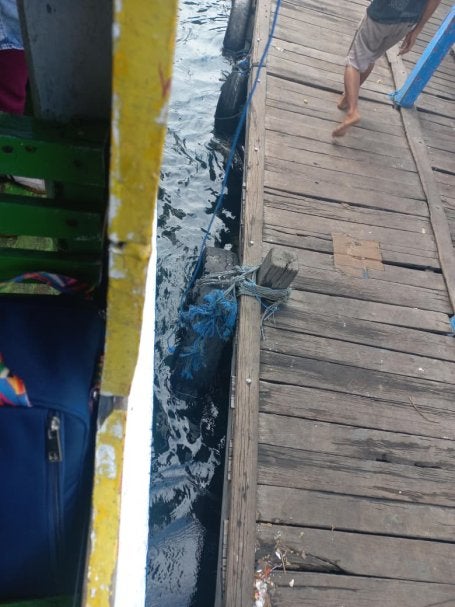
The journey to Barrang Lompo shows how life on the island moves at a different rhythm. Midway through the trip, a boat drew closer. From our boat, a crew member threw a plastic bag containing chilies to the other boat. The other crew caught it, demonstrating a common practice among islanders to distribute goods born from the need for logistical access. As the boat slowly approached the Barrang Lompo pier, our disembarkation process followed a similar pattern to our departure. A wide gap between the boat and the land became an obstacle, requiring some of us to be assisted to reach the pier.
Kredit foto: Keisha Rahadini/WRI Indonesia, Nur Rihadatul Aisyah/PARKIR Makassar
Uncertainty as the Rhythm of Life for Island Communities
Sea conditions dictate the rhythm of life and mobility for island communities. Nature, rather than a fixed schedule, regulates citizens' movement through a constant "negotiation". Residents must constantly read the wind direction and wave conditions while waiting for boat availability before deciding to travel. Furthermore, high fuel prices, driven by logistical challenges and administrative problems at Fishermen's Fuel Stations (SPBN), complicate these journeys¹. Islanders view traveling to the mainland city of Makassar as a complex decision, since boats operate only once a day in each direction.
This dependency creates economic uncertainty for island communities. For fishermen in Barrang Lompo, wind and waves determine both their ability to go to sea and the eventual sale of their catch. Bad weather and impassable seas prevent them from fishing. However, the problem persists beyond the weather. Fishermen must immediately sell catches, such as fish, lobsters, and sea cucumbers, to collectors or transport them to mainland Makassar. Bad weather limits access to crossings and hinders the distribution of this catch. On the other hand, catch has a short shelf life and the island lacks daytime electricity, seafood storage remains less than optimal.
When the Right to Mobility is Not Fully Available
Walking prompted broader questions regarding how the larger system works and how island communities perceive access and movement. The mobility experience on the islands shows that the discourse of “Makassar as an Inclusive City” has not yet fully addressed accessibility issues in the island. From a legal perspective, this does not align with Law Number 8 of 2016 on People with Disabilities. Article 18 guarantees the right of access to the independent use of public facilities, while Article 98 requires accessibility in public services, including transportation. In practice, boarding and disembarking at the dock still require external assistance, as the area lacks adequate ramps and a mooring system that supports independent mobility.
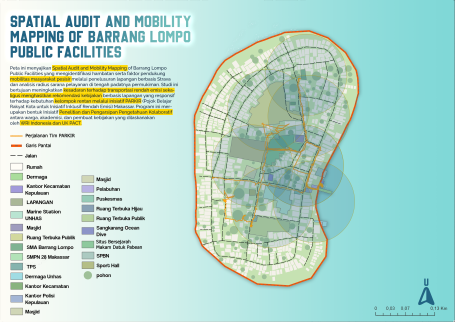
Ministerial Decree No. 8 of 2023 exhibits a similar gap, as it emphasizes the provision of safe, comfortable, and accessible transportation for all users, including vulnerable groups. Authorities have not yet fully implemented these standards in islands, particularly at crucial points like piers and other basic service facilities. We conducted field observations by tracing the main public service routes in Barrang Lompo to understand how island communities perceive accessibility in their daily lives.
Credit: Andi Batario Tenratu/PARKIR Makassar
Our route on the island covers areas connected to various public facilities, including community health centers, police stations, sub-district offices, Public Service Malls, village offices, schools, and mosques. Analysis of the service points reveals that public services concentrate within certain corridors on the island. However, spatial proximity does not necessarily provide equal access. Narrow road conditions, uneven surfaces, and slopes at specific points remain obstacles, especially for vulnerable groups and people with disabilities.
Kredit foto: Nur Rihadatul Aisyah/PARKIR Makassar, Junaidi/PARKIR Makassar
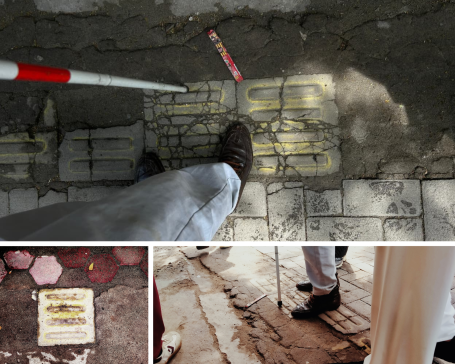
Several road sections on the island feature guiding blocks, but they remain useless because many are damaged, end abruptly, or have degraded due to tidal wave impacts and sand cover. The width of the road to several service points ranges from 2 to 3.5 meters, and the surfaces are uneven. In addition, the sub-district office and community health center provide ramps, but the slopes are inappropriate. The slope reaches 9 degrees at the sub-district office and 12 degrees at the community health center.
In practice, these slopes, particularly at the community health center, pose potential hazards because they do not fully account for track length and surface safety. "The steepness of the road to the health center does not comply with universal design principles and is dangerous for persons with disabilities and the general public," said Fajrin after testing both ramps. On the other hand, regulations provide clear direction. For example, Ministerial Decree No. 8 of 2023 emphasizes the importance of providing safe, comfortable, and accessible transportation for all users, including vulnerable groups. However, its implementation in the island is absent from the community's daily experience.
The Sea That Gives, The Sea That Tests
On Barrang Lompo Island, the sea connects residents to livelihoods, healthcare access, fish distribution, and the mainland city of Makassar. However, complete dependence on maritime mobility also places island communities in a state of constant vulnerability, especially sea cucumber divers.
Some residents choose to dive for sea cucumbers amid economic pressures and limited employment opportunities on the island. Sea cucumbers have a high market value, so many still choose to hunt them despite their increasing scarcity and high risks. In practice, divers often use equipment that fails to meet safety standards, using compressors that were never actually designed for human breathing underwater.
These economic drivers force coastal communities to negotiate risk in their daily lives. Residents often sacrifice safety to support economic mobility. “Those who have money can continue their studies or work in the city, but many young people on the island end up going to sea to help their parents catch sea cucumbers because they have no other choice," said Jamal, a team member who is also a native of the island.
The risks of diving practices extend beyond work accidents, directly impacting their mobility and ability to perform daily activities. Some fishermen return from the sea with weakened bodies, experiencing nervous disorders or even paralysis due to diving³. When the body can no longer move optimally, it affects access to work, health services, and daily mobility
Life on the island is even more vulnerable because it depends so heavily on the physical ability to move and to cross the sea. Bad weather conditions can hamper access to Makassar. In addition, residents experiencing health problems find that traveling to a referral health facility in Makassar is not always easy or fast. While we observed a motorcycle ambulance meant to serve medical needs within the island, residents facing a medical emergency that requires referral to a hospital in mainland Makassar usually have to rent other residents' jolloros or use police boats for emergency crossings. This process takes a long time, especially since the journey to Makassar takes one hour under normal conditions.
After walking around the island for two hours, we returned to our starting point with one question: to what extent can a city be called inclusive if some of its residents must still risk their safety and independence just to get around? If Barrang Lompo residents must still rely on assistance to access transportation and risk their lives to get around, then inclusivity is not yet fully realized. The city government needs to ensure that accessibility is truly in place by evaluating public facilities, improving dock systems and sea transportation, and adjusting infrastructure in accordance with universal design principles. These steps will help realize mobility that no longer depends on assistance but instead becomes a right that the entire community can access independently, including in Barrang Lompo.
1, 2 Based on the story of Kiki, a member of the diving and environmental community at Sangkarrang Ocean Dive, a native of Barrang Lompo Island.
3 Based on the story of Ismail, a member of the diving and environmental community at Sangkarrang Ocean Dive, a native of Barrang Lompo Island