Featured WRI Experts:
Commemoration of Kartini Day: Women’s Leadership and the Future of Ambitious and Inclusive Climate Policy and Action

Since the world reached consensus through the Paris Agreement a decade ago, more women have taken seats at global decision-making tables. At the UNFCCC COP30 meeting in 2025, more than one-third of heads of delegation were women. This is not merely a statistic but an important factor in the Gender Action Plan: designing decisions that consider vulnerability factors for groups such as women and children is crucial.
Women and children are among the most affected groups during disasters. Because of this vulnerability, they should not be positioned only as “victims”; instead, women and other vulnerable groups need to be empowered as the main drivers of climate action.
In Indonesia, the commitment to inclusive climate change mitigation is reflected in implementation and regulations, such as in the RPJPN and RPJMN. These documents include emission reduction targets as macro development indicators from the Ministry of National Development Planning (Bappenas); as well as national climate commitment documents such as the LTS-LCCR (2021) and the Second NDC (2026) through the Ministry of Environment. At the provincial level, this commitment is also reflected in the Regional Low Carbon Development Plan (RPRKD). However, inclusive implementation and processes require the involvement of various stakeholders.
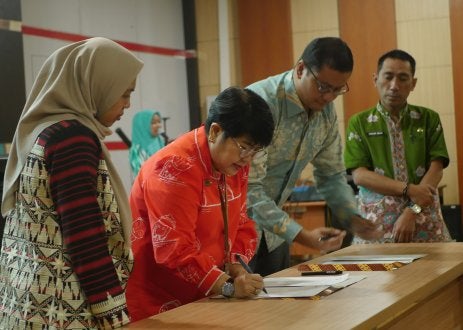
WRI Indonesia has been providing technical assistance for discussions on data collection, validation of findings, and the inventory of medium- and long-term sectoral policies in South Sumatra Province since 2025. In this process, WRI has held discussions on data collection, validation of findings, and the inventory of medium- and long-term sectoral policies, together with regional government organizations (OPD) in South Sumatra Province, with Bappeda as a strategic partner.
South Sumatra Province is one of the provinces with the largest peatland areas in Indonesia and has mangrove areas covering 28% of the total mangrove area on Sumatra Island. Mangrove areas in this province have provided ecological and economic benefits to communities across generations through marine products, protection against climate disasters, and tourism potential. At the same time, the coal mining sector contributes economically, with more than 10% of national coal production coming from this province. With emissions reduction targets in the green transition, it is essential to achieve long-term economic growth while maintaining responsible resource management, environmental sustainability, and social well-being.
As part of this process, WRI Indonesia conducted interviews with Ariyati, Head of the Regional Development and Environment Subdivision at Bappeda South Sumatra Province; Wira Swadana, Climate Action Senior Lead at WRI Indonesia; and Egi Suarga, Senior Manager for Climate at WRI Indonesia. Our conversation explored how economic growth priorities and low-emission targets can advance without leaving women and communities behind.
What is the connection between climate issues and society? Can low-carbon development bring social welfare, especially for vulnerable groups and women?
Ariyati:
“As policymakers, the government needs to ensure that the policymaking process considers the aspirations and needs of the community. In addition, policies need to be translated into short-term, medium-term, and long-term economic and social benefits from climate change mitigation actions.
For example, we are trying to implement sustainable agricultural practices. Therefore, in addition to training farmers, we need to demonstrate how these practices can increase long-term crop yields and give economic benefits. We also need to involve women and children within the family environment, by supporting financial literacy education for women and providing education with local content in schools for environmental conservation, such as education about peatlands and mangroves, which are crucial ecosystems in South Sumatra Province.”
Wira Swadana:
“Planning climate action at the regional level needs to consider two sides: ensuring that development is carried out with sustainable principles and building resilience as a response to the impacts of climate change. Therefore, it is important to ensure that community participation, especially by vulnerable groups such as women, the elderly, and children, is not only as beneficiaries but also as active policy-makers and participants in designing just and inclusive policies. This is where the just transition aspect becomes an approach that can answer sustainable and inclusive low-emission development.”
Egi Suarga:
“Analysis by WRI Indonesia, together with Bappenas, shows that development scenarios that still focus on the exploitation of extractive natural resources can trap economic growth at an average of 5.1% in 2025–2045 (below the target range of 6–7%). On the other hand, the implementation of green economy principles can encourage economic growth of up to 6.3% from 2025 to 2045 and create 1.7 million new green jobs by 2045, accounting for 38% of the additional labor force. However, it is important to ensure that these green job opportunities are gender-inclusive by providing women with equal access to emerging sectors such as renewable energy, waste management, and the circular economy, which have historically been dominated by men.
WRI Indonesia’s model simulation shows that various low-carbon development policies can support greenhouse gas emissions-reduction targets while also promoting stable economic growth and creating new jobs in sustainable development sectors. In this context, the involvement of women as agents of change –whether as workers, business actors, and decision-makers—is key to ensuring that economic and environmental benefits are shared equitably and sustained over time.”
Reflecting on South Sumatra Province today, how can we further emphasize the active participation of women in climate policy-making?
Ariyati:
“I was involved in the reactivation of the Low Carbon Development and Climate Resilience Working Group (Pokja PRK-PBI), which now has a regulatory basis through the South Sumatra Governor’s Decree and Standard Operating Procedures. In my view, the working group is a strategic and fundamental platform, especially within the policy structure, that provides a space that guarantees active participation from various stakeholders, from the smallest level within community groups to the provincial level, in environmental management and climate action at the district and provincial levels.
Then, I also see the importance of women leaders as role models. I learned leadership systems from two figures at Bappeda South Sumatra, namely Ms. Regina Ariyanti and the late Dr. Ekowati Retnaningsih, S.KM., M.Kes. Leaders ensure the implementation of policies that are not only business-as-usual but also comprehensive, multi-year, and data-driven.
I learned how leadership that is detailed, persistent, determined, and empathetic carries out policy interventions and climate planning, and the importance of ensuring these efforts are continued by the next leaders. Women’s leadership enriches decision-making perspectives that prioritize processes and open space for participatory problem-solving.”
Wira Swadana:
“In the long term, the government has established regulations to support a green economic transition. WRI Indonesia supports Bappenas’ efforts to develop various studies on emissions-reduction processes across sectors. As part of this transition, we are also advancing discussions on resilient climate governance to ensure the transition not only addresses future climate challenges but also builds a comprehensive ecosystem for society.
At the regional level, we need to strengthen local implementation by applying low-emission development planning and incorporating the Just Transition approach with active community involvement, including women.”
What strategic steps are needed to ensure that the direction of long-term low-carbon development, especially at the provincial level, is implemented inclusively?
Ariyati:
“The strategy of low-carbon development policy, both in relation to spatial planning and the environment, is not only related to infrastructure, but also to economic and social aspects, with a strong focus on climate and environmental issues. At the grassroots level, we see women becoming vocal advocates for the environment and climate. This is one of our key focuses in translating climate-related policies to communities, as well as encouraging women to become primary drivers of climate action through their involvement in decision-making processes.”
Wira Swadana:
“Not only for South Sumatra Province, but in general. A holistic approach, rather than a sectoral one, is one of the most effective strategies for ensuring a just transition to low-emission development. With a cross-sectoral approach, not only in the energy sector, but also in waste, agriculture, IPPU, and FOLU sectors, we can ensure that Just Transition principles are implemented sustainably.”
Egi Suarga:
“At the local government level, each region needs to consider its socio-economic characteristics, geography, potential, and challenges, so that development targets and policies are aligned with the local context and based on local wisdom and advantages. For example, the focus of low-carbon development policy in South Sumatra Province, which has extensive peatlands, will differ from that in Bali Province, which has a tourism-based economy.
One key priority is ensuring that policies at the national, provincial, and district/city levels are implemented in an integrated manner, taking into account the respective authorities and explicitly incorporating gender-responsive approaches, including capacity building and participation in planning processes. This is crucial, as national emission reduction targets can’t be achieved without contributions from all regions, including a significant role of women as local development actors.”