Explore more:
climate
Indonesia's Nickel Tailings: Can Governance Catch Up with Waste Generation? – Webinar Summary

Image by
Paul Hunt at Unsplash
Indonesia's nickel boom is drastically changing the global map of nickel supply, including in the clean energy transition. However, as no production can go without waste, it is also creating a waste crisis on a staggering scale. Indonesia’s nickel industry trajectory will likely rely on HPAL (High Pressure Acid Leach) refineries, which produce tons of tailings. Tailings are the leftover fine-grained waste materials produced during the mining and extraction process after valuable minerals have been separated from raw ore. Unfortunately, tailings contain numerous toxic chemicals and are categorized as hazardous waste.
According to a new analysis by the Energy Shift Institute (ESI), Indonesia's HPAL refineries are projected to generate 1.4 billion tonnes of hazardous tailings by 2035—ten times the volume stored today. To put that into perspective, the waste would be enough to blanket the entire city of Jakarta in a layer more than one meter deep. Yet the risks are no longer hypothetical. In March 2025, the collapse of three tailings storage facilities in Morowali, Central Sulawesi, claimed the lives of four workers, even though current waste volumes represent only a fraction of what the industry is expected to produce in the coming decade. This highlights the pressing challenges for nickel tailings governance in Indonesia.
To discuss the crucial challenges and possible mitigations, WRI and ESI in Indonesia convened a webinar titled "Indonesia's Nickel Tailings: Can Governance Catch Up with Waste Generation?” The webinar brought together around 300 participants from research, government and policy, industry, and sustainability practitioners to examine the rapid expansion of high-pressure acid leaching (HPAL) nickel processing, the environmental and safety risks associated with its tailings, Indonesian regulations in the provision of tailings management, international best practices, and the gaps between Indonesia's regulatory framework and international ESG standards.
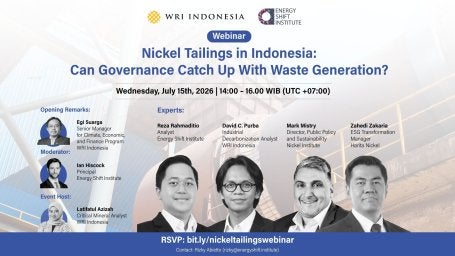
Egi Suarga, Senior Manager for Climate, Economic, and Finance Program, WRI Indonesia, in the opening remarks, said, “Tailings management can have far-reaching environmental, social, and economic consequences around. We have seen how tailings management failure can damage ecosystem public trust and expose companies' governance to substantial financial risks. This webinar is timely, as it explores both the challenges and the opportunities for strengthening governance in Indonesia's critical mineral sector.”
The context-setting presentation delivered by Reza Rahmaditio, analyst from the Energy Shift Institute, showcased findings from ESI's research on nickel tailings in Indonesia. The findings suggest an immediate response to fill the gaps in Indonesia's current regulatory framework by adopting a consequence-based or risk-based framework aligned with international standards. Particularly, these regulations must address the lack of specific requirements for dry-stack tailings to withstand the region's extreme rainfall and active seismic faults, while concurrently addressing persistent challenges related to enforcement and oversight. This presentation was later followed by a panel discussion to dissect and discuss the findings.
The panel discussion, moderated by Ian Hiscock, principal at the Energy Shift Institute, brought together David Purba, Industrial Decarbonization Analyst at WRI Indonesia; Mark Mistry, Director of Public Policy and Sustainability at the Nickel Institute; and Zahedi Zakaria, ESG Transformation Manager at Harita Nickel. The discussion examined tailings governance from policy, international industry, and operational perspectives.
Regulation-wise, Indonesia has several key aspects of hazardous waste management, environmental approvals, mining practices, and reclamation guarantees. In tailings regulations, for instance, there are Minister of Environment and Forestry Regulation No. 5 of 2021 on Procedures for Issuing Technical Approvals and Operational Feasibility Certificates in the Field of Environmental Pollution Control and Ministry of Energy and Minister of Energy and Mineral Resources Regulation No. 26 of 2018 on the Implementation of Good Mining Practices and the Supervision of Mineral and Coal Mining. David Purba from WRI Indonesia mentioned, “Through our latest ESG gap analysis, we believe that there are gaps to improve from current regulations, such as creating an enabling environment for companies to adhere to the standards.” David also emphasised on the need to develop practical guidelines for companies to map existing Indonesian permits and compliance evidence against international standards, identify gaps, and determine the additional measures required to meet international expectations.
Mark Mistry of the Nickel Institute provided an international perspective on tailings management, noting that HPAL tailings are not unique to Indonesia and are also managed by nickel producers in countries including the Philippines, Australia, Brazil, and Cuba. He stressed, “Indonesia, like many countries, has specific conditions which need local adaptation in tailings management solutions. By identifying risks and managing them systematically, we can slowly move to improve to a more credible tailings governance.”
Lastly, from an industry perspective, Zahedi Zakaria argued that the main challenge in implementing dry-stack tailings management in Indonesia is not necessarily the upfront capital cost. Instead, the key challenge is developing the technical expertise and operational knowledge needed to apply dry stacking effectively under Indonesia's tropical and seismic conditions. He added, “Tailings recycle opportunities are open wide, partly to recover valuable materials such as iron, since current technology has not yet reached full commercial scale. In this case, circular economy approaches can be part of the solution to reduce long-term storage of tailings.”
In closing, Ian Hiscock concluded, "The wave of new HPAL facility development in Indonesia represents a significant milestone. It enables more efficient utilisation of the country's mineral resources while reducing operating costs across industrial estates, thereby enhancing Indonesia's international competitiveness. However, proper tailings management is essential to safeguarding communities and ecosystems.”
Bridging the gap between Indonesia’s current national regulatory framework and international standards will require more than just legislative adjustments. It also demands tailored, science-based baselines, specialized technical expertise for tropical and seismic conditions, and proactive circular economy innovations. By uniting robust governance with operational excellence, Indonesia can successfully safeguard its communities and ecosystems while cementing its position as a sustainable leader in the global nickel supply chain.
For the webinar recording click here https://bit.ly/WRITailingswebinar